



Edward Goldstein
He has been testing AI models longer than most people have known what a token is. He breaks things, takes notes, and writes it up. No agenda, no sponsors.
%201.png)
GLM-5.3 delivers near-frontier agentic coding and autonomous tool execution at a fraction of the cost of proprietary models. Integrating GLM-5.3 through AnyAPI.ai's unified gateway eliminates single-provider downtime and rate limits via automated load balancing and dynamic fallback routing.
This developer guide walks through migrating from OpenRouter to AnyAPI with zero downtime by updating base URLs, API credentials, and model identifiers while leveraging OpenAI SDK compatibility. It covers mapping model strings for top 2026 models like GPT-5.6 and Claude 5, configuring automated provider fallbacks, and managing a 10% canary traffic rollout.
Building scalable agentic workflows requires pairing high-tier reasoning orchestrators like Claude Fable 5 with specialized, ultra-fast sub-agents for parallel tool execution and data extraction. Routing these multi-model architectures through the AnyAPI Unified Gateway delivers optimal performance, cost efficiency, and zero-downtime provider fallbacks across both proprietary and open-weight models.

This technical benchmark reveals that Moonshot AI's Kimi K3 outperforms OpenAI's GPT-5.6 Sol in speed, delivering 2.7x faster Time-To-First-Token latency and 50% higher throughput for agentic workflows. By deploying AnyAPI's dynamic model routing to leverage Kimi K3 for high-volume tasks, engineering teams can slash their production LLM expenses by nearly 68% without compromising output quality.

AI platforms can cut monthly token costs by 80-92% by routing tasks through multiple Chinese models (DeepSeek V4 Flash, GLM-5.2, Kimi K3) via AnyAPI instead of expensive Western flagships. This tiered routing strategy maintains quality while dramatically reducing spend for large-scale production systems.
This comprehensive guide analyzes the shifting architecture of 2026 AI infrastructure, detailing why stable, direct API routing is critical to preventing cascading failures in long-running agentic loops. By comparing OpenRouter’s crowd-sourced marketplace with AnyAPI.ai’s enterprise-grade gateway, the article demonstrates how advanced semantic caching and programmable fallbacks deliver the predictable latency required for commercial production.
A unified LLM API acts as a standardized abstraction layer that eliminates vendor lock-in by allowing developers to connect to multiple AI providers through a single integration. By simplifying infrastructure, this approach enables instant model switching, automated failovers, and optimized cost management for production-grade applications.
This article compares the best LLM API providers for production AI apps, including AnyAPI.ai, OpenAI, Anthropic Claude, Google Gemini, Mistral, Groq, OpenRouter, AWS Bedrock, Azure AI Foundry, and Cohere. It explains how developers can choose the right provider based on model quality, cost, latency, reliability, compliance, and routing needs.
To bypass vendor lock-in and production downtime, teams are replacing OpenAI with alternatives like Anthropic Claude for advanced logic, Google Gemini for massive context, and AnyAPI.ai for multi-model failover routing. By adopting a unified multi-model architecture, developers can cut API costs and build highly resilient, agentic software using a single integration key.
Claude is still one of the best APIs for coding and agentic workflows, but in 2026 its high pricing, rate limits, and downtime risk make relying on Anthropic alone a bad production strategy. The smartest move is to compare strong alternatives like OpenAI, Gemini, DeepSeek, and Mistral, or better yet use a unified router like anyapi.ai to get automatic failover, lower costs, and one sane billing layer.
GPT 5.5 Spud is the ultimate action model that dominates terminal environments and agentic execution, while Claude Opus 4.7 remains the superior architect for deep reasoning and complex multi-file coding projects. One model excels at doing the work on your machine, whereas the other is the specialized tool for high-stakes analysis in legal, financial, and engineering domains.

So what are the actual alternatives in April 2026? I spent the last few weeks testing the major AI coding assistants. I looked at their exact pricing, their token efficiency, and whether they survive when you throw a 50k-line codebase at them.
AI tools deliver measurable ROI for small businesses by automating repetitive tasks like writing, customer support, and admin work - often saving 5–10x their monthly cost. The key is starting with one clear bottleneck, letting AI handle 80% of the work, and measuring results from day one.
Big AI models are losing favor in enterprises because they’re expensive, slow, and often unnecessary for simple tasks. Smaller, specialized models (1B–17B parameters) can match or outperform massive ones when properly trained, while offering better efficiency, privacy, and on-premise control.
In 2026, AI intelligence has become a low-cost commodity, with the market shifting toward high-performance "mini" models. This guide identifies the most cost-effective providers for developers.
Learn how to build a resilient, "AI-first" scraper by pairing OpenClaw with AnyAPI.ai. This guide covers how to leverage OpenClaw’s autonomous navigation while using AnyAPI as a unified gateway to access top-tier models like GPT-4o and Claude 4.5. By routing your requests through a single API key, you can ditch fragile CSS selectors and stop juggling multiple LLM subscriptions, creating a future-proof data extraction pipeline that just works.

Learn how to use generative AI securely without risking your data. Discover zero data retention APIs, local models, and prompt sanitization tactics for AI privacy 2026.
%201.svg)
Building a chatbot is no longer “AI magic”. It’s about clean message handling, conversation state, and choosing the right model interface. This guide walks beginners from zero to a working chatbot using a modern, provider-agnostic AI API setup.
%201.svg)
Discover how pairing Cursor, the AI-powered code editor, with custom prompts can supercharge your development workflow, helping you code 10 times faster while maintaining precision and control. This guide explores practical strategies for developers and teams to leverage these tools for real productivity gains.

AI is revolutionizing marketing by enabling personalized, data-driven strategies that boost engagement and ROI. This article explores practical guides and case studies to help developers and teams integrate multi-provider AI and LLM infrastructure effectively.
In 2025, AI music generators are transforming how developers build interactive audio experiences, with top tools offering seamless API integration for everything from custom soundtracks to generative apps. This guide explores the best options, highlighting their technical strengths and how they enable scalable, multi-provider AI workflows.
%201.svg)
China’s open-source AI ecosystem is exploding with speed and scale the West can’t ignore. But is it really “dominating,” or is the story more complicated?
AI art generators have become cultural mirrors, and lately what they reflect says more about us than about art. When “famous billionaire as a reptile” tops the charts, it’s not just a meme - it’s a signal.
Autonomous AI agents are reshaping how businesses operate at the customer-facing level. In sales and support departments, they've moved beyond being helpful tools - they're becoming the primary workforce.
AI agents are no longer hype — they’re quietly transforming how work gets done. From triaging data pipelines to writing documentation, AI agents that “work while you sleep” are redefining what productivity means for developers and teams.
AI terminology can feel overwhelming, even for seasoned developers. Understanding the foundational terms behind today’s LLMs, orchestration tools, and AI infrastructure is the key to building smarter, faster, and more interoperable systems.
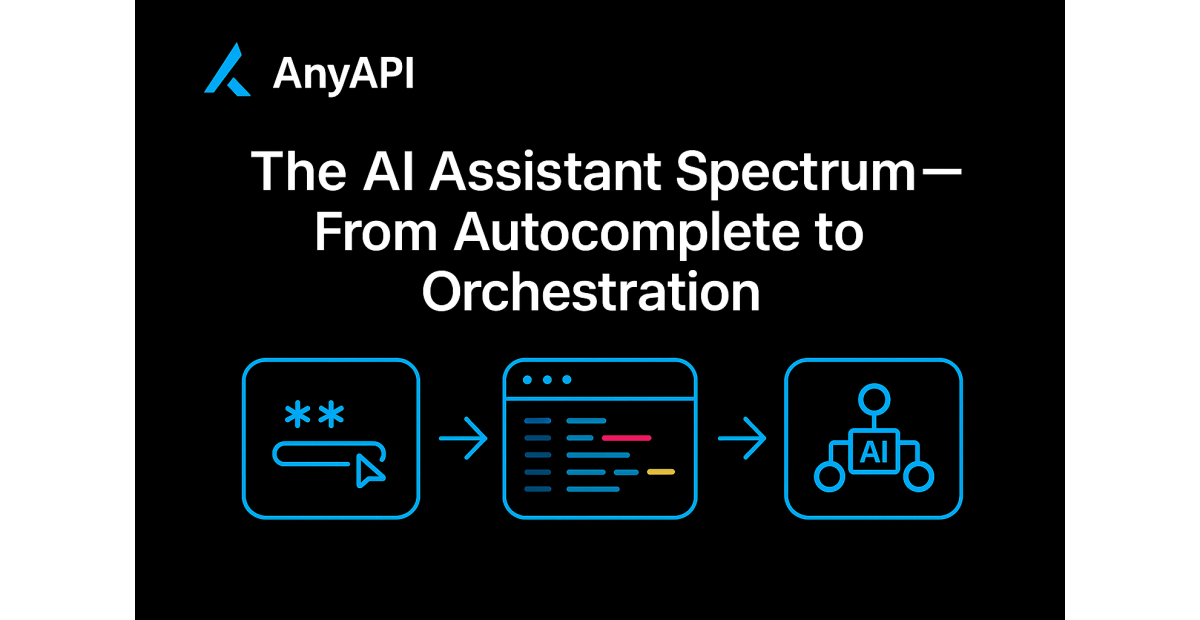
Cursor and GitHub Copilot represent two different philosophies of AI-assisted development - one focused on context and editing, the other on completion and integration.
Function calling is the backbone of most LLM-powered workflows today. But juggling different LLM APIs with their own JSON structures and idiosyncrasies? It’s a productivity killer. Let’s fix that.
LLM costs can spiral fast, especially at scale. Here’s how to make your AI stack leaner without compromising on performance.
In the race to handle increasingly complex, multi-thousand-token tasks, two LLMs are leading the charge: Claude and Gemini. But which one actually performs better in long-context scenarios, and why does it matter for your product?

Stream LLM output to React with Server-Sent Events. Backend (Node/Express) and frontend (React) code with error handling, reconnection, and a comparison to WebSockets. Build real-time AI responses.
AI APIs promise speed, intelligence, and convenience, but hidden costs can pile up fast. Learn how to build smarter, more sustainable AI infrastructure without burning your budget.
As new LLMs flood the market and AI infrastructure becomes more fragmented, hardcoding a single provider is no longer scalable. Learn how model routing can optimize for cost, quality, and resilience without rearchitecting your product every quarter.
Retrieval‑Augmented Generation (RAG) was the breakthrough of 2023–2024 for grounding LLMs in factual data. In 2025, the frontier has moved to real‑time, knowledge‑aware systems. This is how product teams can make the leap.

Microsoft’s latest AI Copilot mode in the Edge browser isn’t just about smarter browsing, it signals a shift toward persistent, embedded agents that follow your workflow, across tabs and tools. Here’s why that matters for AI builders.

Turning dense PDFs and unstructured documents into digestible AI-generated video summaries used to sound futuristic. Now it’s productized, and it’s changing how users interact with complex information. Here’s what devs and product teams can learn from Google’s move with NotebookLM.
xAI’s upcoming Grok 4 model isn’t just another chatbot, it’s a signal that LLMs are heading off the page and into physical environments. Here’s what developers can learn from the Grok x Tesla integration, and how it reshapes the future of agentic AI.
Natural Language Processing (NLP) is powering the most transformative AI experiences today, from chatbots to content summarization. But what exactly is NLP, and why should developers and product teams care in 2025?

What exactly is an AI agent, and how do they go beyond prompt/response models? This guide breaks down how autonomous systems work and how to start building with them today.
Generative AI has moved from academic labs to production stacks. This guide explains what it is, how it works, and how to use it to build real-world applications that scale.

Startups are under pressure to deliver smarter features fast. See how product teams are integrating AI with fewer headaches and more flexibility. From MVP to scale, here’s how one API makes it possible.

Discover 16 top AI sales tools for 2025 that boost lead generation, automate workflows, and increase conversions for all businesses.
.png)
The AI code editor landscape in 2025 is dominated by powerful tools like Cursor AI, GitHub Copilot, and specialized solutions for different developer needs.