




A coding assistant that suggests a short function has a different job from one that investigates a bug across an entire repository. The first needs a fast, useful response. The second may have to read several files, run tests, and revise its approach. Paying for the strongest model on every request can be wasteful, but choosing solely by token price can leave developers fixing the assistant's mistakes.
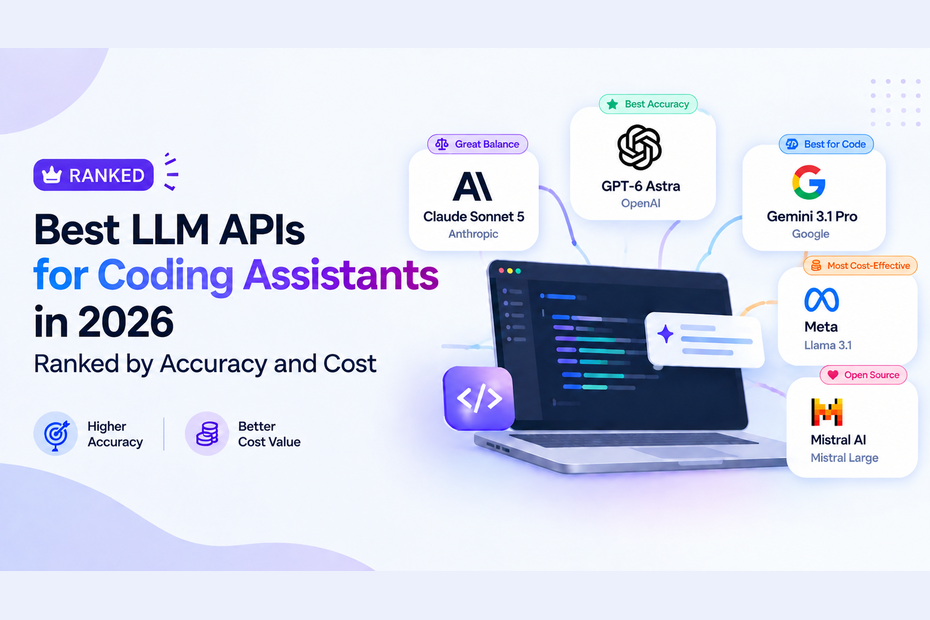
This ranking of the best LLM APIs for coding assistants considers both coding ability and the cost of completing a task. It is a shortlist for testing, not a promise that one model will win in every codebase.
How the Models Were Ranked
For complex work, accuracy means more than producing code that looks plausible. A useful assistant should understand the request, change the right files, preserve existing behavior, and respond sensibly when a test fails. Benchmark results offer a starting point, but your own tasks should decide the final choice.
Cost also needs context. A cheaper request is not a saving if it takes repeated prompts and substantial developer review to get a working fix. Compare the total cost of reaching an accepted result, along with response time and the amount of human correction required.
The first two models below have a directly reported comparison on the independent Artificial Analysis Coding Agent Index. The remaining options are included as lower-cost candidates to test on narrower or more frequent tasks.
1. GPT-6 Astra: Strong Accuracy at a Lower Cost Per Complex Task
GPT-6 Astra is a sensible first test for repository-level changes, debugging and longer coding workflows. In Artificial Analysis's Coding Agent Index, it tied Claude Fable 5.1 while costing roughly 60% as much per evaluated task. That is a more useful comparison than input token price alone: an agent may make many calls while exploring files, using tools, and checking its work.
A GPT-6 coding benchmark result does not mean every assistant should send every request to Astra. A quick explanation of an error message may not need the same level of reasoning as a multi-file fix. Test it where an incorrect change would create meaningful rework.
AnyAPI lists GPT-6 Astra among the models accessible through its unified API, allowing teams to compare it with other models using a consistent integration.
2. Claude Fable 5.1: A Close Choice for Difficult Work
Claude Fable 5.1 belongs on the same complex-task shortlist. It matched GPT-6 Astra on the coding-agent evaluation cited above, although its cost per evaluated task was higher. That makes the choice less about declaring a universal accuracy winner and more about how each model performs in your repository.
Give both models the same bug reports, relevant files, and test access. Compare whether they find the cause, keep changes focused, and explain any uncertainty. If one consistently needs less developer correction on your hardest tasks, the higher API spend might be justified. If their accepted results are similar, cost becomes a stronger deciding factor.
AnyAPI also lists Fable 5.1, so teams using its gateway can include the model in that comparison.
3. GLM 5.3 Flash: A Candidate for Cost-Sensitive Workloads
Not every coding request needs a frontier model. GLM 5.3 Flash is worth testing for frequent tasks such as explaining code, drafting small functions, or preparing an initial set of tests. AnyAPI describes it as a cost-optimized coding and agentic model in its catalogue.
Its position here is a practical testing priority, not a claim that it ranks third on every coding benchmark. Run it against the same examples used for the larger models. Pay attention to whether it follows project conventions and whether its output passes the checks your team already uses. A lower-cost model earns a place in production only when it completes the assigned task reliably.
4. GPT-5.6 Terra: An Everyday Model to Evaluate
GPT-5.6 Terra offers another option for routine coding assistance. AnyAPI positions it as a more cost-conscious choice for everyday interactive and agentic work than a frontier model used for the hardest requests.
It may suit an assistant that answers questions about a codebase, suggests contained edits, or helps developers work through errors. Test those jobs separately from large refactors. A model can be useful for quick, supervised suggestions even if a stronger one is needed when the assistant must make and verify several connected changes.
Match the API to the Assistant's Jobs
A coding AI models comparison is most useful when it reflects what users ask your assistant to do. Build a small set of real tasks: a straightforward code explanation, a failing test, a bug spanning several files, and a change with strict project conventions. Give every model the same context and tools, then record accepted results, time, and total usage.
If you are choosing an AI coding assistant API, check how easily your app can switch models as well as how each model performs. A unified gateway can simplify that testing and help route different tasks to different models. The LLM API for code generation you use for everyday suggestions does not have to be the one you use for a difficult repository fix.
Start with the task, measure the complete result, and keep the developer in control of changes. That produces a more useful ranking for your product than any single headline benchmark.