




For years, defaulting to the OpenAI API was the standard play for building AI-powered software. You initialized the client, dropped in gpt-5 or gpt-4-turbo, and called it a day.
But in 2026, the landscape looks fundamentally different. The AI ecosystem has shifted from a single-player monopoly to a hyper-competitive, multi-polar market. Engineering teams have realized that relying solely on OpenAI introduces severe vulnerabilities: sudden rate-limit throttling, unannounced model behavior shifts, strict and sometimes unpredictable content moderation filters, and the ever-looming threat of single-point-of-failure downtime.
Furthermore, with the rise of complex agentic workflows and multi-modal software, no single provider excels at everything. You might need the deep logic of Claude for coding tasks, the massive context window of Gemini for legal document parsing, and the ultra-low-cost inference of open-source models like DeepSeek V4 or Llama 4 for high-volume summarization.
If you are looking to diversify your AI infrastructure, optimize your margins, or build a more resilient system, this guide breaks down the absolute best OpenAI API alternatives available to full-stack developers and enterprise architects today.
Why Teams Are Moving Away from OpenAI Direct API in 2026
Building production-ready software requires reliability, predictability, and margin control. Relying entirely on OpenAI's direct endpoints introduces three major engineering challenges:
- The Vendor Lock-In Trap: Standardizing your entire codebase around a single proprietary SDK makes you hostage to their pricing tiers, deprecation timelines, and terms of service. If OpenAI changes its data privacy policies or drops a model version your app relies on, your engineering team faces an emergency rewrite.
- Agentic Latency and Cost Inefficiencies: AI agents often require dozens of sequential LLM calls to complete a single task. Routing basic routing logic or simple JSON extraction to a top-tier frontier model like GPT-5.5 drains your runway. Conversely, relying on lower-tier models can break complex loops.
- Redundancy and Downtime Vulnerabilities: Even the largest tech infrastructure experiences outages. If your application handles live user queries, B2B workflows, or automated customer support, a 30-minute OpenAI API outage means lost revenue and broken SLAs.
Key Evaluation Criteria for LLM API Alternatives
When auditing alternative API providers, our technical content strategy team evaluates the landscape across five critical pillars:
- Drop-in Compatibility: Does the provider support the OpenAI-compatible request/response schema? If migrating requires refactoring your entire data validation layer, the switching cost is too high.
- Context Window Efficiency: Can the model handle large inputs (100K+ tokens) without experiencing "needle-in-a-haystack" retrieval degradation or skyrocketing costs?
- Instruction Following & Structured Output: Does the model natively support strict JSON mode or tool/function calling with 99.9% reliability? This is essential for modern agentic stacks.
- Cost per Million Tokens: What is the exact input/output pricing dynamic compared to OpenAI’s current baseline?
- Time-to-First-Token (TTFT): How fast does the model begin streaming responses? For real-time chat, search, or voice agents, milliseconds matter.
The Best OpenAI API Alternatives: Provider Breakdown
1. Anthropic Claude API — Best for Deep Reasoning and Complex Coding Agents
Anthropic remains OpenAI’s most formidable direct competitor. With the release of the Claude 4.6 and 4.7 model families, Anthropic has captured a massive share of the developer market—specifically teams building software development agents, advanced automated workflows, and high-precision RAG pipelines.
- Why it replaces OpenAI: Claude Sonnet 4.6 consistently outperforms OpenAI's equivalent models on complex system prompt adherence, coding benchmarks (SWE-bench), and nuanced multi-step logic.
- Key Advantage: Adherence to complex system instructions. While OpenAI models sometimes "drift" or ignore constraints mid-conversation, Claude follows intricate operational boundaries flawlessly. It also features a highly reliable 200K token context window.
- The Catch: Anthropic lacks a built-in native image generation API (like DALL-E 3) and fine-tuning endpoints are heavily gated compared to OpenAI's self-serve dashboard.
2. Google Gemini API — Best for Massive Context and Budget-Friendly Prototyping
Google Cloud has aggressively optimized its AI Studio and Vertex AI offerings. The Gemini 3.1 and 3.2 engine families have established Google as the absolute leader in context length and multi-modal inputs.
- Why it replaces OpenAI: If your application processes long video clips, entire code repositories, or hundreds of pages of PDF manuals in a single prompt, OpenAI’s 128K context window falls short. Gemini offers a staggering 1 million to 2 million token context window.
- Key Advantage: Pricing disruption and a generous free tier. Gemini Flash costs as little as $0.075 per 1M input tokens—making it up to 10x cheaper than OpenAI's standard mini models. Furthermore, Google AI Studio offers a free tier for developers to prototype without entering a credit card.
- The Catch: The native SDK structure differs significantly from OpenAI's design pattern, meaning you will need a wrapper or intermediary layer to normalize requests.
3. DeepSeek & Open-Source Infrastructure (Together AI, Groq, Fireworks)
In 2026, you no longer need to rely on proprietary, closed-source models to achieve GPT-level intelligence. The open-source community, led by Meta's Llama 4 and DeepSeek V4, has commoditized frontier performance.
- Why it replaces OpenAI: Cost and sovereignty. Providers like Together AI, Groq, and Fireworks AI host these open-source models on hyper-optimized hardware stacks, exposing them via standard APIs.
- Key Advantage: Groq offers unparalleled, real-time speeds (often exceeding 400+ tokens per second on Llama models using specialized LPU hardware). DeepSeek V4 provides a stunning 95% of GPT-4o's utility at roughly 15% of the operational cost, entirely eliminating high API overhead for startups.
- The Catch: Managing multi-tenant open-source endpoints means you have to keep track of multiple smaller hosting vendors, each with varying geographic availability and rate limits.
2026 Feature and Pricing Comparison Matrix
The Architectural Shift: Why Multi-Model Routers Are Winning
The raw data proves that looking for a single replacement to OpenAI is the wrong architectural approach for 2026. True production resilience doesn't come from switching your dependency from one closed garden (OpenAI) to another (Anthropic).
Instead, top-tier engineering teams are moving toward Multi-Model API Gateway Architecture.
A modern production AI setup rarely sends 100% of its traffic to one model. A standard cost-optimization and reliability pattern looks like this:
- Route 70% of routine traffic (basic classification, minor text cleanups) to an ultra-cheap, ultra-fast model like DeepSeek V4 or Gemini Flash.
- Route 25% of traffic requiring deep contextual reasoning, complex code generation, or strict JSON tool-use to Claude Sonnet 4.6.
- Keep OpenAI GPT-5/4o or Claude Opus 4.7 reserved for the top 5% of edge cases that genuinely demand extreme, graduate-level reasoning.
Implementing this pattern manually requires maintaining multiple SDKs, dealing with separate billing accounts, and writing custom middleware to handle provider failovers.
This is where AnyAPI.ai comes in.
How to Migrate from OpenAI to AnyAPI in 5 Minutes
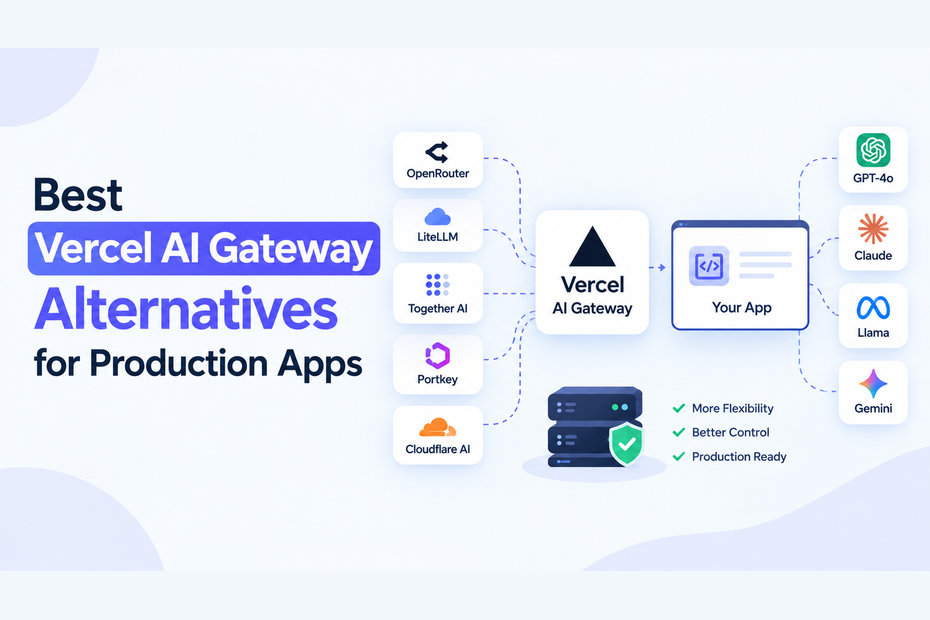
AnyAPI.ai abstracts away the entire fragmentation of the AI market. It gives you a single, unified, OpenAI-compatible endpoint to access over 400+ LLMs, vision engines, image generators, and speech translation models.
By making a simple two-line change in your environment variables, you instantly gain access to the entire alternative ecosystem with automatic fallback protection.
Step-by-Step Implementation
1. Install your preferred SDK
Because AnyAPI natively mirrors the OpenAI request specification, you can keep using the standard openai library in your Node.js or Python backend.
Bash
npm
install openai
# or
pip install openai
2. Initialize the Client with AnyAPI Endpoint
Swap out the base URL and drop in your unified AnyAPI token. You can now call any model from any provider seamlessly.
// Import the OpenAI SDK — works as a universal client
import OpenAI from 'openai';

// Point the client to AnyAPI instead of OpenAI directly
const openai = new OpenAI({
  apiKey: process.env.ANYAPI_API_KEY, // Your key from anyapi.ai
  baseURL: 'https://api.anyapi.ai/v1', // Universal gateway — replaces api.openai.com
});

async function generateAIResponse() {
  const response = await openai.chat.completions.create({

    // Just change this one string to switch providers
    // anthropic/claude-3-5-sonnet, google/gemini-pro, meta/llama-3, etc.
    model: 'anthropic/claude-3-5-sonnet',

    messages: [
      // System prompt — sets the role and context for the model
      { role: 'system', content: 'You are an elite backend engineer architecture assistant.' },

      // User message — the actual request
      { role: 'user', content: 'Write a secure middleware for JWT validation in Go.' }
    ],

    // Low temperature = precise and deterministic responses
    // 0 = fully predictable, 1 = creative and varied
    temperature: 0.2,
  });

  // Extract the text from the first completion choice
  console.log(response.choices[0].message.content);
}
Why AnyAPI.ai is the Ultimate OpenAI Alternative
- Unified Consolidated Billing: No more managing corporate credit cards across OpenAI, Google Cloud, Anthropic, and AWS Bedrock. You receive a single invoice based entirely on your total token consumption across all models.
- Built-in Production Resiliency (Auto-Failover): If OpenAI goes down, AnyAPI can automatically rerun your failed request against Claude or a hosted Llama instance within milliseconds based on rules you define. Your end-users never notice a hiccup.
- Unrivaled Modality Diversity: While OpenAI limits you to DALL-E for images and Whisper for audio, AnyAPI connects you to modern specialized generation stacks like Flux, Recraft, Stable Diffusion XL, ElevenLabs, and Deepgram Aura—all via the exact same integration layer.
Ready to Bulletproof Your AI Infrastructure?
Don't let your application suffer from vendor lock-in, unannounced API price hikes, or unexpected service outages. Switch to AnyAPI.ai today. Get access to 400+ world-class models with a single API key, consolidated billing, and enterprise-grade failover infrastructure.
[Create Your Free Developer Account Now]
Frequently Asked Questions (FAQ)
What is the best free alternative to the OpenAI API?
Google AI Studio offers the most generous free tier on the market for its Gemini models (including Gemini Flash and Pro). It provides high-rate limits for prototyping and testing without requiring immediate billing commitments.
Can I use OpenAI client libraries with alternative models?
Yes. Platforms like AnyAPI.ai build an OpenAI-compatible routing proxy layer. This ensures that your existing backend code utilizing openai.chat.completions.create remains perfectly valid—you only need to update your baseURL and change the target model string.
Which model alternative is best for building autonomous AI agents?
Anthropic’s Claude Sonnet 4.6 is widely considered the industry gold standard for agentic workflows. It excels at multi-step planning, tool/function selection, and tightly adheres to complex system frameworks without breaking character or violating structured JSON data shapes.
How does multi-model routing affect data privacy?
When using a unified gateway like AnyAPI.ai, your data handles are protected under strict zero-data retention (ZDR) enterprise agreements with upstream providers. Your prompts are never used to train open-source or proprietary baseline models.