




Choosing the best LLM API provider used to be simple: pick the most capable model, connect an API key, and ship. In 2026, that approach is no longer enough.
The LLM API market now moves fast. OpenAI has released GPT‑5.5 for complex reasoning and coding workflows, Anthropic has introduced Claude Opus 4.8 with a 1M context window, Google continues to expand Gemini for multimodal and long-context workloads, and infrastructure-focused providers such as Groq, OpenRouter, Mistral, AWS Bedrock, Azure AI Foundry, and unified API platforms are changing how developers build AI systems.
For production teams, the real question is not “Which model is best?” It is:
Which LLM API provider — or combination of providers — gives your application the right balance of quality, latency, cost, reliability, compliance, and flexibility?
This guide compares the best LLM API providers for developers, SaaS teams, AI agents, RAG systems, copilots, automation workflows, and production AI infrastructure.
Why choosing an LLM API provider is an infrastructure decision
An LLM API is not just a model endpoint. It affects your product’s performance, reliability, unit economics, security posture, and ability to adapt when new models launch.
If your app depends on one provider, you inherit that provider’s:
- pricing changes;
- rate limits;
- outages;
- latency profile;
- model deprecations;
- regional availability;
- content policy changes;
- SDK changes;
- context window limits;
- tool-calling behavior;
- response formatting differences.
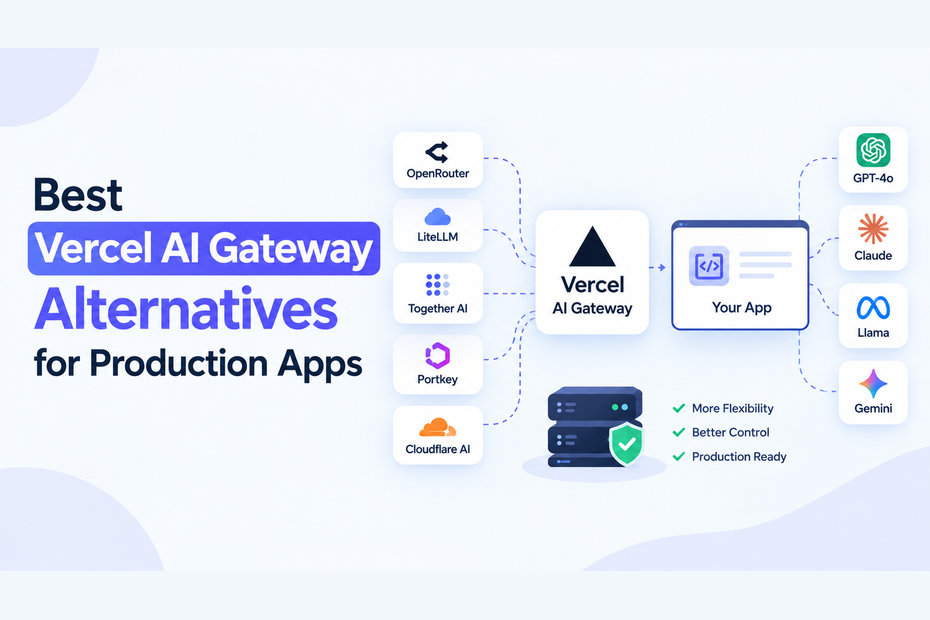
That is why many production teams now treat LLM access as an infrastructure layer. Instead of hardcoding one model, they build routing, fallback, monitoring, and cost controls around multiple providers.
This is also why unified API platforms are becoming more important. AnyAPI.ai, for example, positions itself as one API for 400+ AI models with OpenAI-compatible access, routing, fallbacks, usage analytics, and infrastructure features designed to reduce vendor lock-in. (anyapi.ai)
What makes a good LLM API provider
Before comparing providers, define what “best” means for your application. The right API for a coding agent may be wrong for a high-volume support bot. The best API for long-context document analysis may be too expensive for simple classification.
Evaluate every LLM API provider across these criteria:
1. Model quality
Look at reasoning, coding, instruction following, multilingual performance, tool use, structured output reliability, and domain-specific accuracy.
For example, GPT‑5.5 is positioned by OpenAI as a frontier model for complex professional work, while Claude Opus 4.8 is positioned by Anthropic as its most capable generally available Opus model with strong coding and agent capabilities.
2. Latency and throughput
Latency matters for chat, copilots, voice agents, autocomplete, and real-time UX. Some providers optimize for frontier quality, while others, such as Groq, focus heavily on fast inference for supported open models. Groq’s pricing page highlights throughput metrics and low-cost inference options for models such as Qwen3 32B. (groq.com)
3. Pricing and cost predictability
Do not compare only input and output token prices. Real cost depends on:
- average prompt length;
- output length;
- reasoning tokens;
- cache hit rate;
- batch discounts;
- retries;
- failed requests;
- tool calls;
- long-context pricing tiers;
- provider markup if using a marketplace.
OpenAI’s GPT‑5.5 page notes that long prompts above a specific threshold can trigger different pricing multipliers, while Anthropic’s pricing docs include prompt caching and batch-processing discounts for supported Claude models.
4. Context window
Context window is critical for legal review, financial analysis, codebase understanding, multi-document RAG, and agent memory.
Anthropic states that Claude Opus 4.8 includes a 1M token context window in the Claude API, and Google’s Gemini API docs highlight long-context support for advanced Gemini models. (anthropic.com)
5. API compatibility
OpenAI-compatible APIs make migration easier. They allow developers to reuse existing SDKs, observability tools, prompt frameworks, and agent libraries.
AnyAPI supports OpenAI-compatible SDK integration by changing the base URL, and OpenRouter also provides a standardized model API for accessing many models through one interface. (docs.anyapi.ai)
6. Reliability and fallbacks
A provider can have the best model and still be the wrong production choice if it has frequent rate-limit issues, region constraints, or no fallback path.
Production teams should design for:
- provider failover;
- model fallback;
- retry policies;
- timeout handling;
- circuit breakers;
- usage caps;
- request logging;
- latency monitoring.
7. Enterprise controls
For regulated teams, provider choice also depends on:
- data retention;
- SOC 2 / ISO posture;
- private networking;
- IAM;
- audit logs;
- region support;
- compliance commitments;
- cloud marketplace billing.
AWS Bedrock and Azure AI Foundry are strong options for teams that need cloud-native governance, IAM, enterprise procurement, and centralized model access. AWS has also expanded Bedrock with OpenAI-compatible and multi-provider model access patterns. (docs.aws.amazon.com)
Best LLM API providers compared
Here is a practical comparison of the best LLM API providers for production use.
DeepSeek’s official pricing docs show an OpenAI-format base URL and live pricing updates, while Cohere’s documentation emphasizes Command models, embeddings, and reranking APIs for retrieval-heavy applications. (api-docs.deepseek.com)
Provider-by-provider breakdown
OpenAI API
Best for: frontier reasoning, coding, agents, tool use, general-purpose AI products.
OpenAI remains one of the strongest default choices for teams that want high-quality models, broad ecosystem support, mature SDKs, and a large developer community. GPT‑5.5 is positioned as OpenAI’s frontier model for complex professional work, with support through the Responses API and Chat Completions workflows. (developers.openai.com)
Use OpenAI when you need:
- strong reasoning;
- coding assistance;
- agent workflows;
- tool calling;
- structured outputs;
- broad framework compatibility;
- stable developer ecosystem.
OpenAI is often the best first provider for startups because documentation, examples, integrations, and community support are extensive. However, production teams should still avoid hardcoding one OpenAI model as their only path. Model pricing, lifecycle, and availability change over time.
Best production pattern: use OpenAI for high-value tasks, then route simpler tasks to cheaper or faster models.
Anthropic Claude API
Best for: coding agents, long-context tasks, complex reasoning, writing-heavy workflows.
Anthropic’s Claude family is especially popular for software engineering agents, long-form reasoning, document analysis, and workflows where instruction-following quality matters. Claude Opus 4.8 is described by Anthropic as its most capable generally available Opus model and supports a 1M token context window on the Claude API. (anthropic.com)
Use Claude when you need:
- coding agents;
- long-context analysis;
- careful reasoning;
- high-quality writing;
- document-heavy workflows;
- agent planning and task decomposition.
Claude is often a strong choice for AI coding tools, legal/document review systems, internal knowledge assistants, and multi-step agentic workflows.
Watch out for: cost at scale, especially for long outputs and large context. Use prompt caching, batching, and routing to keep unit economics under control.
Google Gemini API
Best for: multimodal applications, long context, Google Cloud-native teams.
Gemini is a strong option for teams building multimodal products that combine text, image, audio, video, and long-context reasoning. Google’s Gemini API reference covers standard, streaming, and realtime APIs, while the pricing page describes access to advanced models and long-context capabilities. (ai.google.dev)
Use Gemini when you need:
- multimodal input;
- long-context document processing;
- Google Cloud integration;
- AI Studio prototyping;
- Vertex AI deployment paths;
- strong price/performance for selected workloads.
Gemini is especially relevant for media analysis, research assistants, multimodal search, educational tools, and apps already built on Google Cloud.
Watch out for: differences between Google AI Studio and Vertex AI pricing, rate limits, and enterprise deployment behavior.
Mistral AI API
Best for: EU-friendly deployments, open-weight strategy, enterprise customization.
Mistral is a good choice for teams that want strong European AI infrastructure, open-weight optionality, and commercial API access. Mistral’s pricing and docs position La Plateforme as a way to access models across text, reasoning, vision, and other capabilities. (mistral.ai)
Use Mistral when you need:
- EU-oriented AI vendor strategy;
- open-weight model optionality;
- lower-cost inference options;
- customization and deployment flexibility;
- alternatives to US frontier labs.
Mistral can be a strong fit for companies with data residency concerns or teams that want more model portability.
Groq API
Best for: low-latency inference and real-time user experiences.
Groq focuses on speed and cost-efficient inference for supported models. Its pricing page shows model-level throughput and token pricing, making it useful for developers who care about latency-sensitive applications. (groq.com)
Use Groq when you need:
- fast response streaming;
- real-time chat;
- lightweight agents;
- autocomplete-like UX;
- high-throughput workloads;
- open-model inference.
Groq is not always the best choice for the most complex reasoning tasks, but it can be excellent for fast, high-volume use cases.
OpenRouter
Best for: model discovery, experimentation, and marketplace-style access.
OpenRouter gives developers access to many models through one API-style interface. Its docs describe a model catalog with standardized metadata and pricing fields, and its pricing page states that model catalog pricing is surfaced to users. (openrouter.ai)
Use OpenRouter when you need:
- quick access to many models;
- experimentation across providers;
- model comparison;
- fallback options;
- access to niche or newly released models.
OpenRouter is useful for prototyping and model discovery. For production, review provider-level routing, retention settings, uptime, and pricing behavior carefully.
AWS Bedrock
Best for: enterprises already standardized on AWS.
Amazon Bedrock is a strong option for teams that need centralized model access inside AWS, IAM controls, cloud-native governance, billing through AWS, and enterprise procurement alignment. AWS documentation describes Bedrock endpoints for model inference and OpenAI-compatible access patterns for supported models. (docs.aws.amazon.com)
Use Bedrock when you need:
- AWS IAM and governance;
- enterprise procurement;
- private networking patterns;
- centralized cloud controls;
- model access within AWS architecture.
Bedrock can be the right choice for regulated enterprises, but the newest frontier models may not always appear on Bedrock at the same time as direct provider APIs.
Azure AI Foundry
Best for: Microsoft enterprise environments.
Azure AI Foundry is compelling for organizations already using Microsoft infrastructure, Azure security controls, enterprise support, and procurement. Microsoft’s model catalog lists GPT‑5.5 as available through Azure AI Foundry with Azure-managed purchasing and infrastructure framing. (ai.azure.com)
Use Azure AI Foundry when you need:
- Azure-native deployment;
- enterprise security;
- Microsoft procurement;
- managed model access;
- integration with Microsoft cloud services.
For many enterprises, Azure is less about cheapest token price and more about governance, access control, and operational fit.
Cohere
Best for: RAG, semantic search, reranking, enterprise retrieval.
Cohere is especially relevant when your application depends on retrieval quality. Its docs cover Command models, embeddings, and reranking models, including Rerank APIs for semantic search and document ranking. (docs.cohere.com)
Use Cohere when you need:
- RAG pipelines;
- reranking;
- enterprise search;
- multilingual retrieval;
- structured knowledge workflows.
Cohere may not always be the first pick for general chatbots, but it is a strong specialist provider for retrieval-heavy AI systems.
DeepSeek
Best for: low-cost reasoning, OpenAI-compatible workflows, open-model experimentation.
DeepSeek’s API docs show an OpenAI-format base URL and model pricing information, making it relatively easy for developers to test with existing OpenAI-style clients. (api-docs.deepseek.com)
Use DeepSeek when you need:
- lower-cost inference;
- OpenAI-compatible integration;
- reasoning models at aggressive pricing;
- experimentation with non-US model providers.
However, teams should review compliance, data governance, geopolitical risk, and security requirements before using DeepSeek in sensitive production workloads.
How to choose the right LLM API for your use case
There is no single best LLM API provider for every product. Use the workload to drive the choice.
For AI coding agents
Start with:
- OpenAI GPT‑5.5;
- Anthropic Claude Opus 4.8;
- Claude Sonnet-tier models for cost-sensitive coding;
- Gemini for large repo context;
- AnyAPI routing for fallback and model comparison.
Coding agents need strong reasoning, tool use, long context, and stable structured behavior. Claude and OpenAI are usually the first providers to evaluate.
For customer support chatbots
Start with:
- cost-efficient OpenAI or Gemini models;
- Mistral or Groq for lower-cost/faster paths;
- Cohere for RAG reranking;
- AnyAPI for routing simple vs complex tickets.
Most support tickets do not need the most expensive frontier model. Route simple FAQ answers to cheaper models and escalate complex cases to stronger models.
For RAG and enterprise search
Start with:
- Cohere Rerank;
- Gemini for long context;
- Claude for reasoning over retrieved documents;
- OpenAI for structured answers;
- AnyAPI for combining retrieval, routing, and fallback.
The quality of retrieval often matters more than the chat model. Invest in embeddings, reranking, chunking, and evaluation.
For multimodal apps
Start with:
- Google Gemini;
- OpenAI multimodal models;
- specialized vision/audio/video models;
- AnyAPI if you need to combine multiple modalities and providers.
Gemini is particularly strong for teams building around multimodal input and Google Cloud workflows.
For real-time apps
Start with:
- Groq;
- fast OpenAI mini/nano-tier models;
- Mistral small models;
- provider routing based on latency.
Real-time UX requires measuring time to first token, streaming performance, and tail latency, not just model quality.
For regulated enterprise workloads
Start with:
- Azure AI Foundry;
- AWS Bedrock;
- direct Anthropic/OpenAI enterprise agreements;
- AnyAPI enterprise controls if multi-provider routing is required.
The best provider is often the one that fits procurement, compliance, audit logging, and regional requirements.
Why production teams use multiple LLM providers
The strongest production LLM stacks are no longer single-provider stacks.
They are multi-provider systems with:
- a default model;
- one or more cheaper models;
- one or more faster models;
- a fallback model;
- a long-context model;
- a reasoning model;
- a multimodal model;
- monitoring and analytics;
- routing policies.
This is because LLM workloads are heterogeneous. A SaaS product may need:
- GPT‑5.5 for complex reasoning;
- Claude Opus 4.8 for coding support;
- Gemini for long-context document analysis;
- Groq for fast chat responses;
- Cohere for reranking;
- Mistral for cost-sensitive EU workloads;
- Bedrock or Azure for enterprise deployments.
Hardcoding one model into your backend makes your product fragile. Routing gives you leverage.
A good routing system can:
- reduce cost by sending simple prompts to cheaper models;
- improve reliability with fallbacks;
- reduce latency by choosing faster providers;
- improve quality by selecting the best model for each task;
- prevent vendor lock-in;
- make model upgrades easier.
How AnyAPI fits into your LLM stack
AnyAPI.ai is designed for teams that do not want to rebuild LLM infrastructure every time a new provider or model launches.
Instead of integrating every provider separately, AnyAPI gives developers a unified API layer for accessing 400+ models, with OpenAI-compatible integration, routing, fallbacks, usage tracking, and infrastructure features. (anyapi.ai)
With direct provider APIs
You manage:
- multiple API keys;
- different SDKs;
- different auth patterns;
- different model names;
- different pricing pages;
- retries;
- fallbacks;
- logging;
- rate limits;
- cost analytics;
- provider-specific quirks.
With AnyAPI
You can centralize:
- model access;
- provider switching;
- fallback chains;
- routing logic;
- cost tracking;
- usage analytics;
- OpenAI-compatible SDK usage;
- experimentation across models.
Example OpenAI-compatible setup:
from openai import OpenAI

client = OpenAI(
    api_key="YOUR_ANYAPI_KEY",
    base_url="https://api.anyapi.ai/v1"
)

response = client.chat.completions.create(
    model="openai/gpt-5.5",
    messages=[
        {"role": "user", "content": "Summarize this customer conversation and extract next actions."}
    ]
)

print(response.choices[0].message.content)
from openai import

OpenAIclient = OpenAI(    api_key="YOUR_ANYAPI_KEY",

base_url="https://api.anyapi.ai/v1")
response = client.chat.completions.create(
model="openai/gpt-5.5",
messages=[        {"role": "user", "content": "Summarize this customer conversation and extract next actions."}    ])print(response.choices[0].message.content)
A production team could then route different tasks to different models:
Or define a fallback strategy:
response = client.chat.completions.create(

 model="anyapi/auto",
messages=[        {"role": "user", "content": "Review this code diff and identify risky changes."}    ])
Model names above should be verified against the live AnyAPI model catalog before publishing or deploying, because provider availability can change.
response = client.chat.completions.create(
    model="anthropic/claude-opus-4.8",
    models=[
        "anthropic/claude-opus-4.8",
        "openai/gpt-5.5",
        "google/gemini-3.1-pro",
        "mistral/mistral-large"
    ],
    messages=[
        {
            "role": "user",
            "content": "Analyze this 80-page contract and flag unusual clauses."
        }
    ]
)
LLM API provider checklist
Use this checklist before choosing a provider for production.
Model capability
- Does the model perform well on your actual prompts?
- Does it support your required modalities?
- Does it handle tool use reliably?
- Does it produce valid structured output?
- Does it follow system instructions consistently?
Cost
- What is the input token price?
- What is the output token price?
- Are reasoning tokens billed separately?
- Is prompt caching available?
- Is batch pricing available?
- Are long prompts priced differently?
- What is your cost per successful user action?
Latency
- What is median latency?
- What is P95 latency?
- What is time to first token?
- Does streaming work reliably?
- Does latency change under load?
Reliability
- What happens during provider outages?
- Are rate limits predictable?
- Can you get higher quotas?
- Do you have a fallback model?
- Do you log failed requests?
Security and compliance
- Is data retained?
- Can retention be disabled?
- Are audit logs available?
- Are regions configurable?
- Does the provider meet your compliance needs?
- Is enterprise support available?
Developer experience
- Is the API well documented?
- Are SDKs stable?
- Is the API OpenAI-compatible?
- Are errors easy to debug?
- Is usage reporting clear?
Portability
- Can you switch models without rewriting your app?
- Can you compare multiple providers?
- Can you route by cost, latency, or quality?
- Can you avoid vendor lock-in?
FAQ
What is the best LLM API provider overall?
For many teams, OpenAI is the best general-purpose starting point because of model quality, ecosystem maturity, and developer tooling. For coding agents and long-context reasoning, Anthropic Claude is often one of the strongest alternatives. For multimodal and long-context workflows, Google Gemini is a strong choice. The best production setup often uses more than one provider.
What is the best LLM API provider for coding agents?
OpenAI GPT‑5.5 and Anthropic Claude Opus 4.8 are strong candidates for coding agents. Claude is often favored for long-context coding workflows, while OpenAI is strong for agentic tool use and broad developer ecosystem support. Test both on your own repositories before committing.
What is the cheapest LLM API provider?
The cheapest provider depends on the model size, output length, discounts, and workload. DeepSeek, Mistral, Groq, and some open-model hosting providers can be cost-effective for specific use cases. However, the cheapest token price is not always the cheapest production cost if quality is lower or retries increase.
What is the fastest LLM API provider?
Groq is a strong option for low-latency inference on supported models. However, real-world speed depends on model, region, prompt length, output length, streaming behavior, and provider load. Always benchmark with your own prompts.
Should I use OpenAI, Claude, or Gemini?
Use OpenAI for broad general-purpose reasoning and agents, Claude for coding and long-context reasoning, and Gemini for multimodal and Google Cloud-connected workflows. For production, consider using all three through a routing layer.
What is a unified LLM API?
A unified LLM API lets developers access multiple AI models and providers through one API interface. Instead of integrating OpenAI, Anthropic, Google, Mistral, Groq, and others separately, developers can use one API key, one SDK pattern, and centralized routing.
Why use AnyAPI instead of calling providers directly?
Use AnyAPI when you want to reduce integration overhead, avoid vendor lock-in, compare models faster, add fallback routing, centralize usage analytics, and access many models through an OpenAI-compatible API layer.
Do I still need provider-specific testing?
Yes. Even with a unified API, you should evaluate models on your own prompts, latency targets, safety requirements, and cost constraints. Unified access makes testing faster, but it does not replace evaluation.
Final recommendation
The best LLM API provider is not a single vendor. It is the provider — or combination of providers — that matches your workload.
Use:
- OpenAI for frontier reasoning and general-purpose agents;
- Anthropic Claude for coding, long context, and careful reasoning;
- Google Gemini for multimodal and long-context workloads;
- Mistral for EU-friendly and open-weight strategies;
- Groq for low-latency inference;
- Cohere for RAG and reranking;
- AWS Bedrock or Azure AI Foundry for enterprise cloud governance;
- AnyAPI when you want one OpenAI-compatible API layer for routing, fallbacks, and multi-model access.
If you are building production AI software, do not design around a single model. Design around a flexible model layer.
With AnyAPI.ai, you can access, compare, route, and scale across 400+ AI models through one API — without rebuilding your infrastructure every time the LLM market changes.