




Consider the absurdity for a moment. A company spins up a 1-trillion parameter model, routes a request through seventeen layers of API infrastructure, burns through enough compute to heat a small apartment, and waits 4.3 seconds. The output: "Meeting rescheduled to Thursday." This is not a hypothetical. This is what passes for AI deployment strategy at a surprising number of Fortune 500 companies right now, and the people paying the cloud bills are starting to notice.
The romance with scale is fading. Not dramatically, not with a press release. It's fading the way bad habits fade: quietly, incrementally, and under pressure from the finance department.
The gospel of "bigger is better" made sense for a while. When GPT-4 arrived, its sheer size felt like the point. Emergent behaviors, reasoning chains, the ability to write a sonnet and a Python script in the same breath. Size was proof. Size was ambition made manifest in silicon. The benchmarks rewarded it. The venture capital rewarded it. The media certainly rewarded it.
But enterprise technology does not run on benchmarks. It runs on latency, compliance audits, and the cost-per-query spreadsheet that some VP of Infrastructure sends around every quarter.
Here is where the story actually gets interesting.
Researchers discovered something that should have been obvious: for the vast majority of real-world business tasks, a model with 3 billion parameters performs almost identically to one with 70 billion, provided you've trained it correctly. The key phrase is "trained it correctly." A general-purpose colossus trying to do everything is, it turns out, worse at specific things than a compact, purpose-built model fed the right data and fine-tuned with discipline.
This is the Goldilocks Zone: models in the 1B to 17B active parameter range. Not so small that capability crumbles. Not so large that costs and latency make deployment a bureaucratic nightmare.
The evidence is now overwhelming. Microsoft's Phi-4-reasoning, at 14 billion parameters, matches the performance of DeepSeek R1 in full, a model with 671 billion parameters, on Olympic-level mathematics benchmarks. Read that again. A model you can run on a single workstation GPU, competing head-to-head with a system that requires a server rack. The explanation is not magic. It is focus: Phi-4-reasoning was built for structured reasoning from the ground up, not for answering trivia and writing birthday poems in the same breath.
Then came Alibaba. In February 2026, the Qwen team released Qwen3.5, a family of models with a trick that sounds simple but is genuinely radical: a Mixture-of-Experts architecture that packs 397 billion total parameters but activates only 17 billion for any given token. The 35B variant activates just 3 billion parameters per forward pass. The practical result is that Qwen3.5-9B, released earlier this month, matches or surpasses GPT-OSS-120B, a model thirteen times its size, across multiple rigorous benchmarks. The small series runs on a laptop. The medium series runs on a single server. All of it ships under Apache 2.0, meaning any company can download it, fine-tune it, and run it behind their own firewall today.
Google's Gemma 3, available from 1B to 27B parameters, adds native image understanding without additional tooling. Mistral's updated compact lineup extends context windows to 256k tokens on models small enough for on-premise deployment. The compact model tier no longer feels like a compromise. It feels like the point.
The Three Pillars that actually drive enterprise decisions are not the ones AI vendors tend to advertise. Nobody is buying a boardroom on "emergent reasoning." The real conversation happens around three things: efficiency, privacy, and specialization.
Efficiency is simple arithmetic. A model running on-device or on a local inference cluster processes tokens faster, at a fraction of the API cost, with no usage caps and no dependency on a third-party uptime guarantee. Qwen3.5-Flash delivers, according to independent benchmarks, responses in one-sixth the time of comparable cloud API calls at one-thirteenth the cost per token. For a manufacturing company running edge inference across 200 factory floors, the difference between a 40ms response and a 400ms response is not academic. It is the difference between catching a fault before a line goes down and writing up an incident report afterward.
Privacy is where the real corporate anxiety lives. Financial institutions, legal firms, healthcare conglomerates, defense contractors: none of them are comfortable sending sensitive internal data to a cloud endpoint they don't control. It doesn't matter how robust the vendor's data processing agreement is. The data leaving the building is a liability, full stop. Running a fine-tuned Qwen3.5-9B or Phi-4-reasoning on a private server, completely air-gapped from the public internet, solves this problem cleanly. A boutique law firm in Frankfurt can now run a specialized legal research assistant on its own hardware, trained on its own case archive, without any of that data touching a third-party data center. That is not a small thing.
Specialization is perhaps the most underrated pillar. A general-purpose frontier model knows a little about everything and a lot about nothing in particular. A fine-tuned compact model, trained on ten thousand annotated customer support tickets from a specific telecommunications company, will outperform frontier systems on that company's support use case. Not because it's smarter in any broad sense. Because it has been made narrow, deliberately, and that narrowness is a feature. Accuracy in context beats raw capability out of context, every time. Gemma 3's built-in visual understanding sharpens this further: a 12B model that reads a factory floor photograph and flags a component defect, running entirely on local hardware, is more useful to a plant manager than any API-dependent frontier model that might be unavailable during a network outage.
The C-suite has learned a new vocabulary. Tokens per second. Active parameter count. Context window costs. Apache 2.0. These were PhD-seminar terms two years ago. They are now line items in technology strategy documents. CEOs who built their AI pitch around "we use the most powerful model available" are quietly rebuilding it around "we use the right model for each task, on our own infrastructure."
This is maturity. It looks less exciting than the previous chapter, but maturity usually does.
Here is the forward-looking part, stated plainly. The AI models that will matter most in five years are not the ones making headlines today. They are the ones you'll never hear about: a Phi-4-reasoning instance embedded in a radiology workflow in Munich, a fine-tuned Qwen3.5-9B running on-premise at a Singapore compliance firm, a quantized Gemma 3 living on a chip inside a wind turbine off the coast of Denmark.
Loud AI, the frontier labs and their trillion-parameter announcements, will continue to generate press and push the theoretical ceiling upward. That work matters. But Quiet AI, compact, sovereign, precise, and ruthlessly specialized, will do the actual work of the world. It will process the invoices, flag the compliance violations, translate the maintenance manuals, and triage the support queues. It will run without fanfare, on hardware companies already own, handling problems companies already have.
The era of bigger is better is not over. It's just becoming the wrong question. The right question is: better at what, for whom, at what cost, on whose servers?
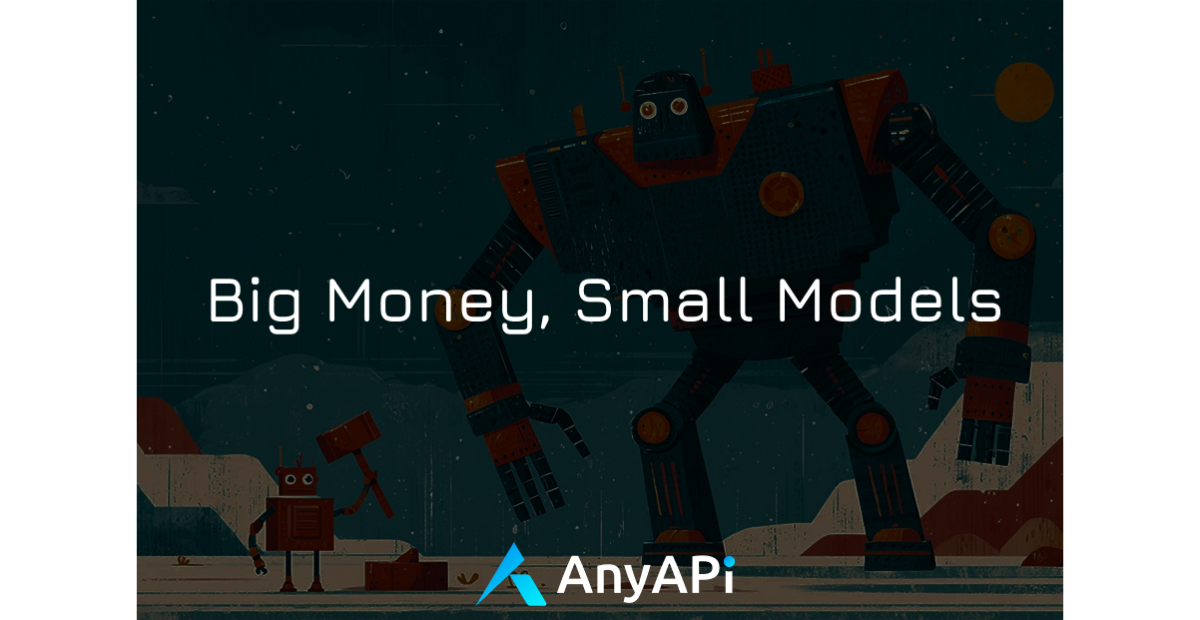
Small, it turns out, is a serious answer.