




A gateway is easy to appreciate when an app uses several AI models. Instead of handling separate keys, request formats, and failure responses throughout the codebase, the app sends requests through one connection. That becomes especially useful when a feature moves from a small test to daily use.
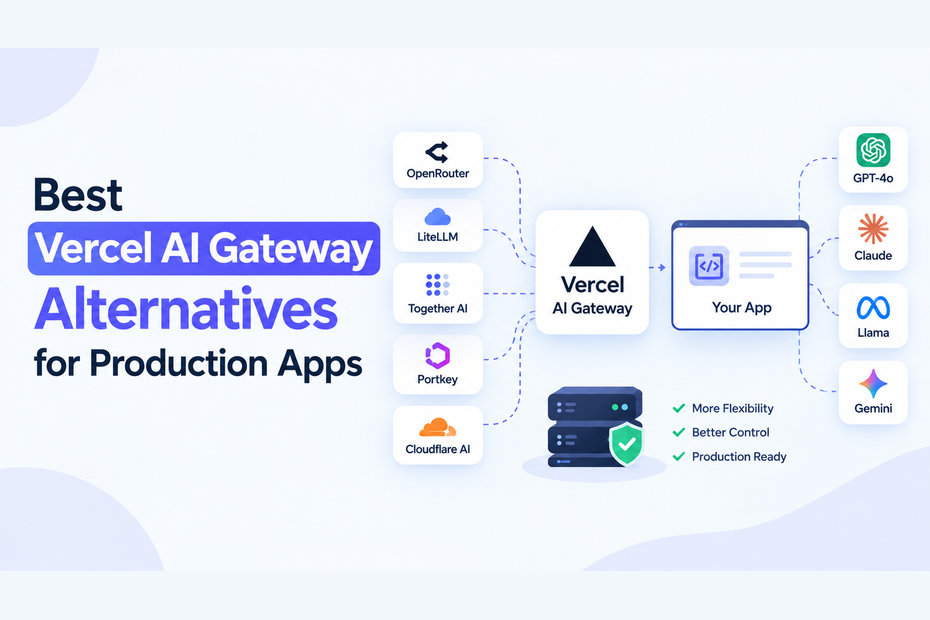
Vercel AI Gateway brings model access, routing, billing, and observability together. It also supports provider routing and model fallbacks. Still, teams may want to compare other gateways because their deployment setup, operating preferences, and model requirements differ. The most useful Vercel AI Gateway alternatives are the ones that fit the way your application is actually run.
What Should a Production Gateway Handle?
A successful demo shows that a model can answer a request. Production raises harder questions. What happens when that model times out? Can another provider handle the same task? Who can see usage by project, and how quickly will the team notice a cost increase?
An AI API gateway comparison should examine more than the number of models listed. Test each option against a few real requests and check:
Integration: How much of the existing app needs to change?
Fallbacks: What happens when a provider fails or reaches a limit?
Visibility: Can the team trace errors, response times, and spending?
Control: Who manages keys, routing rules, and model access?
Operations: Is the gateway managed for you, or will your team run it?
These questions help separate features that sound similar on a product page but work differently in day-to-day use.
OpenRouter: A Broad Model Catalogue
OpenRouter gives you one API to reach models from multiple providers. If your app already uses the OpenAI SDK, the OpenAI-style interface may fit well. You can also swap the model for each request. On top of that, you can set fallback options. This lets you avoid making a new integration for every single provider.
It is worth testing how a preferred model is routed and what happens when the first choice is unavailable. A backup model may answer successfully but produce a different style or level of detail. For user-facing features, that difference matters as much as whether the request technically succeeds.
OpenRouter is a practical option for teams that frequently compare models and want a managed connection to a large catalogue.
LiteLLM: Control Over Your Own Gateway
LiteLLM takes a different approach. Its proxy provides a common interface to multiple model providers, with routing, retries, and fallbacks. Teams can deploy it within their own infrastructure and configure access for different users or projects.
That control comes with operational work. Someone must deploy the proxy, monitor it, maintain its supporting services, and plan for traffic spikes. The team should also verify that budgets and limits behave as expected in its chosen deployment configuration.
For an organization that already runs internal services and wants close control over its AI traffic, that trade-off may make sense. A smaller team seeking minimal infrastructure work may prefer a managed service.
Portkey: Detailed Production Management
Portkey combines a unified API with routing and fallback controls. It also places emphasis on observing requests and managing how models are used across an application.
Consider it when the difficult part of your AI feature is no longer making a model call, but understanding what happened to each call. A support team, for example, may need to investigate slow responses or see whether a fallback was used during a provider issue.
Before choosing it, map the controls your team needs. Advanced configuration is useful when someone will actively maintain the policies and use the resulting data.
AnyAPI: One Integration Across Models
AnyAPI also offers a unified API for multiple providers. Its website describes model switching, smart routing, fallbacks, and usage tracking, alongside developer tools for testing requests. That makes it relevant to teams looking for an LLM gateway for production apps without operating their own proxy.
AnyAPI lists GPT-6 Astra in its model catalogue. If your team needs a GPT-6 API gateway, confirm the model's current availability, supported request features, and cost for your intended workload. Then test a less expensive or faster model on the same tasks. A gateway makes switching possible; your tests determine when switching is worthwhile.
AnyAPI is a reasonable option to evaluate when the goal is to keep provider connections and usage information in one place. As with every gateway, check its behavior with your application's real traffic rather than relying only on a feature list.
How to Make the Choice
There is no universal winner among AI gateway alternatives. A Vercel-based team may find that Vercel AI Gateway already meets its needs. A team prioritizing model exploration may look closely at OpenRouter. LiteLLM suits teams prepared to manage a proxy, while Portkey and AnyAPI offer different managed approaches to production controls.
Build a short trial around three situations: a normal request, a slow or failed provider request, and a week of expected usage. Compare the output, recovery behavior, visibility, and cost. The right gateway is the one your team can understand and operate when the AI feature is busy, slow, or behaving unexpectedly.