




Imagine this: It’s 9:00 AM on a Tuesday. Your generative AI SaaS platform just crossed 10,000 active users. Suddenly, your engineering Slack channel explodes with alerts. Your application is throwing thousands of HTTP 429 Too Many Requests errors. OpenAI is experiencing an unexpected global outage, or perhaps an enterprise user just ran a massive script that exhausted your rate limits.
Your user interface freezes, customer support tickets skyrocket, and churn begins in real-time.
In the era of production-grade AI, relying on a single upstream model provider is an architectural single point of failure (SPOF). To build enterprise-ready Large Language Model (LLM) applications, you need a bulletproof failover system.
This comprehensive guide breaks down AI model fallbacks, why they matter, how to design them, and how to implement zero-downtime redundancy without polluting your codebase with infinite try-catch loops.
The Fragility of Single-Model AI Applications
When building a traditional software-as-a-service (SaaS) application, you expect database engines and hosting providers to guarantee 99.99% uptime. However, the LLM ecosystem operates differently. Upstream AI providers are managing unprecedented compute demands, shifting model weights, and massive global traffic spikes.
If your application talks directly to one specific API endpoint—and only that endpoint—your application's availability is capped by that provider's stability.
When an upstream provider drops, it doesn't just slow down your app; it completely halts features like conversational chat, automated data extraction, or agents executing critical background tasks.
What is an AI Model Fallback Strategy?
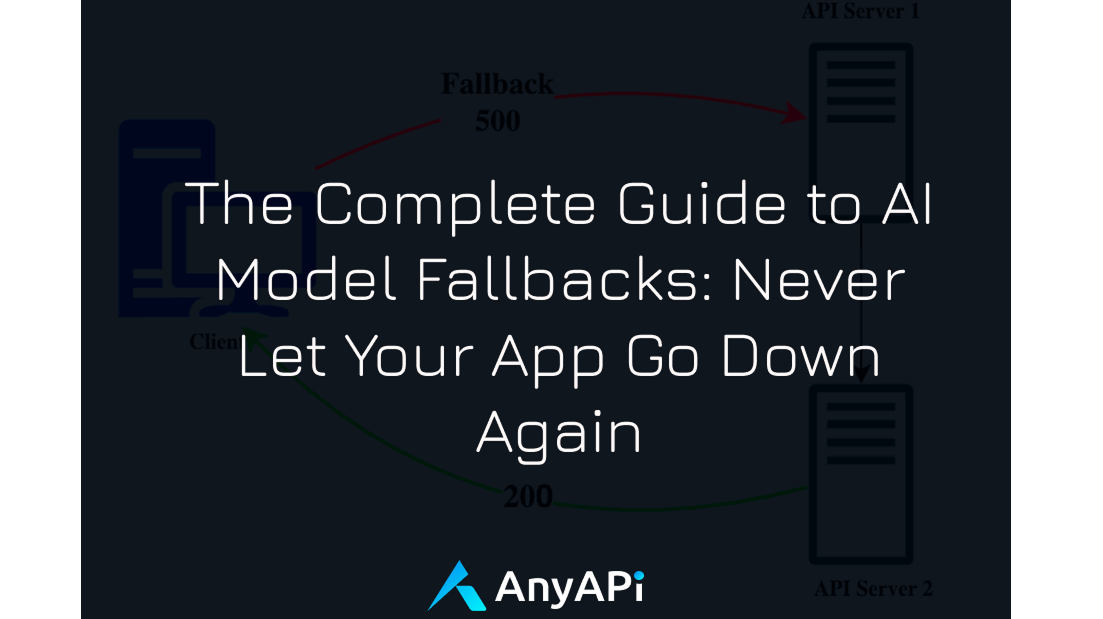
An AI model fallback is a resilient architectural pattern where an application automatically routes an API request to an alternative LLM or a secondary provider if the primary model fails to respond successfully within acceptable parameters.
Think of it as a smart network router for intelligence. If your primary path is blocked, the router instantly switches lanes to ensure the payload arrives safely at its destination.
A robust fallback strategy ensures that instead of seeing an error screen, your end-user experiences nothing more than a marginal, often unnoticeable shift in latency or response formatting.
Common Trigger Events for LLM Failover
To implement an effective failover system, your application code or middleware needs to monitor and intercept specific execution anomalies. The most common triggers include:
1. HTTP 429 (Too Many Requests / Rate Limits)
The most frequent culprit. Even with tier-5 enterprise accounts, unexpected concurrent user spikes can blow through your Tokens Per Minute (TPM) or Requests Per Minute (RPM) thresholds.
2. HTTP 5xx (Internal Server Errors)
Whether it's an overloaded cluster at Anthropic, a networking hiccup at Google Gemini, or an outright cloud outage, 500, 502, and 503 errors happen regularly in the fast-moving AI infrastructure space.
3. Context Window Exceeded Errors
Sometimes, user input dynamically swells past the maximum context limit of your primary model. Instead of hard-failing, a fallback strategy can route that specific long-tail request to a model with a massive context window (e.g., switching to Gemini 3 Pro).
4. Excessive Latency (Timeouts)
Sometimes an API doesn't crash—it just crawls. If a primary model takes longer than a predefined threshold (e.g., 8 seconds) to return a token or response, a timeout trigger should cancel the request and fire the fallback path.
Architectural Patterns for Implementing Fallbacks
Depending on your product’s strictness regarding output quality and cost constraints, you can design your LLM redundancy using three core patterns:
Pattern A: Identical Model Tier Fallback (Provider Redundancy)
- Concept: Falling back from a flagship model of one provider to a flagship model of another.
- Example:
gpt-5➔claude-4-5-sonnet. - Best For: Applications where output quality, reasoning capability, and structured JSON output accuracy cannot be compromised under any circumstances.
Pattern B: Cost & Speed Optimization Fallback (Degraded Elegance)
- Concept: Falling back from an expensive, highly complex model to a faster, cheaper, smaller model.
- Example:
gpt-5➔gpt-5-mini(ormistral-large➔mistral-small). - Best For: Consumer applications where keeping the service online is more critical than deep analytical processing during a high-traffic emergency.
Pattern C: Cross-Region Redundancy
- Concept: Staying within the same provider ecosystem but routing requests to alternative cloud regions or hosting providers (e.g., moving from OpenAI's direct API to Azure OpenAI instances hosted in different geographic data centers).
The DIY Approach: Implementation and Pitfalls
Many engineering teams start by writing hard-coded abstraction wrappers in their backend services. Let’s look at what that looks like in a typical Node.js/TypeScript environment:
import OpenAI from 'openai';
import Anthropic from '@anthropic-ai/sdk';

const openai = new OpenAI();
const anthropic = new Anthropic();

async function generateAIResponse(prompt: string): Promise<string> {
  try {
    // Attempt Primary Request
    const response = await openai.chat.completions.create({
      model: "gpt-4o",
      messages: [{ role: "user", content: prompt }],
      timeout: 5000 // 5-second timeout
    });

    return response.choices[0].message.content || '';

  } catch (error: any) {
    console.warn(
      "Primary LLM failed. Initiating fallback mechanism...",
      error.message
    );

    // Check if error warrants a failover switch
    if (
      error.status === 429 ||
      error.status >= 500 ||
      error.name === 'TimeoutError'
    ) {
      try {
        // Attempt Secondary Request with different schema structure
        const fallbackResponse = await anthropic.messages.create({
          model: "claude-3-5-sonnet-20241022",
          max_tokens: 1024,
          messages: [{ role: "user", content: prompt }],
        });

        return fallbackResponse.content[0].text;

      } catch (fallbackError) {
        throw new Error(
          "Critical Failure: Both primary and fallback LLMs are unreachable."
        );
      }
    }

    throw error;
  }
}
Why the DIY Approach Fractures at Scale
While the code snippet above works for basic string generation, it rapidly becomes a maintenance nightmare in real-world production systems:
- SDK Mismatch & Maintenance: Every provider uses entirely distinct SDK parameters, payload structures, and response objects. Handling streaming responses (
Server-Sent Events), function calling (tools), and structured JSON schemas across separate SDKs multiplies your code volume exponentially. - Config Rigidity: If you want to alter your fallback order (e.g., swapping your secondary model from Anthropic to DeepSeek), you have to modify your application logic, run tests, commit code, and trigger a CI/CD deployment pipeline.
- Observability Black Hole: Centralizing telemetry data (tokens consumed, costs incurred, individual provider latency spikes) across different SDK exceptions is incredibly difficult to normalize.
The Modern Alternative: Native Fallbacks via AnyAPI
Instead of building, maintaining, and debugging complex custom fallback layers, modern software engineering teams decouple infrastructure routing from their core application code using AnyAPI.ai.
AnyAPI provides a single, unified, high-performance API layer for all major AI foundation models. It standardizes input and output payloads, eliminates SDK bloating, and handles advanced fallback and failover execution configurations directly inside a centralized dashboard or simple API configuration array.
How it Works with AnyAPI
When using AnyAPI, your application speaks to a single endpoint using a unified JSON body format. You simply define an array of targets in your routing parameters. If the first model errors or drops, AnyAPI seamlessly handles the switch server-side before returning the payload to your application server.
Example Request:
curl https://api.anyapi.ai/v1/chat/completions \
  -H "Authorization: Bearer $ANYAPI_API_KEY" \
  -H "Content-Type: application/json" \
  -d '{
    "model": "gpt-4o",
    "fallback_models": ["claude-3-5-sonnet", "gemini-1.5-pro"],
    "messages": [
      {
        "role": "user",
        "content": "Analyze our system architecture security metrics."
      }
    ],
    "fallback_conditions": {
      "status_codes": [429, 500, 502, 503],
      "timeout_ms": 6000
    }
  }'
Why This Changes Everything for AI Product Teams:
- Zero Code Adjustments: You can alter, add, or reprioritize your fallback stack dynamically without deploying a single line of backend code.
- Unified Tooling / Function Calling: AnyAPI handles the background transformation of function parameters and JSON schemas across different provider specifications automatically.
- Global Latency Reductions: Because the retry and fallback mechanics happen close to the edge on AnyAPI's high-speed routing infrastructure, your application bypasses cross-country network roundtrips during an active failover event.
Best Practices for Multi-LLM Redundancy
To maximize the efficacy of your high-availability AI infrastructure, adhere to these fundamental principles:
1. Normalize Your System Prompts
Different LLMs interpret system instructions and prompting formats differently. While Anthropic models respond highly to detailed, structured examples XML-style markdown, OpenAI models excel with conversational, straightforward imperative lists. When picking fallback variants, evaluate your prompts across both models to find a universally acceptable middle-ground template.
2. Strictly Enforce JSON Schema Validation
If your app expects a rigid JSON structure to parse data directly into a database, a fallback model might introduce slight format variations. Ensure you use robust JSON Schema validation rules or enforce strict response formatting attributes across all models specified in your routing queue.
3. Account for Multi-Model Costing Structures
Be aware that fallback paths can drastically skew your infrastructure budgeting. If your primary path relies on cheaper input costs and your fallback shifts traffic to an expensive, high-reasoning alternative, an active provider outage could unexpectedly drive up your daily API spending. Set up comprehensive automated anomaly alerts inside your billing control panel.
4. Regularly Simulate Outages ("Chaos Engineering")
Do not wait for a major global provider outage to find out if your fallback configuration works. Regularly run automated integration tests where you intentionally force mock network connection timeouts or pass faulty API tokens to trigger your failover pipelines.
Conclusion: Build Infrastructure That Adapts
Building a successful AI application requires moving past the proof-of-concept phase and structuring your tech stack for enterprise resilience. Your users care about speed, continuous uptime, and reliable workflows. They don't care which cloud datacenter or foundation model fulfills their query under the hood.
By decoupling your application logic from brittle single-provider setups and utilizing an intelligent, unified routing network like AnyAPI.ai, you ensure that your platform remains operational, performant, and reliable—no matter what happens upstream.
Ready to build bulletproof AI apps? > Sign up for AnyAPI.ai today and activate native multi-model fallbacks, unified tracking, and enterprise routing redundancy with less than ten lines of code.
Frequently Asked Questions
Q: Will using a fallback model increase the response latency for my users?
If your primary model responds perfectly, there is zero latency penalty. If the primary model fails or times out, the user will experience a slight delay equal to your defined timeout threshold plus the execution time of the fallback model. By utilizing edge-routers like AnyAPI, this delay is kept to an absolute minimum.
Q: How do I manage streaming text tokens across a model fallback switch?
If a primary model fails before it starts emitting tokens, the fallback system simply boots up the secondary model seamlessly. If it fails mid-stream, the server-side router terminates the broken connection and passes the state to the fallback model to complete the generation request smoothly.
Q: Is it expensive to maintain accounts across multiple LLM vendors?
If you manage individual accounts directly with OpenAI, Anthropic, Cohere, and Google, managing several developer accounts, credit lines, and usage quotas becomes an operational bottleneck. Using AnyAPI.ai eliminates this completely by providing a centralized dashboard with a unified billing line item for all target upstream providers.