




When evaluation teams select an LLM provider, the first column they check on the pricing page is Cost per Million Tokens (CPMT). Marketing departments pitch $0.15 input / $0.60 output per million tokens, convincing engineering teams that running LLM features will cost pennies.
Six months later, when the workload scales to production, the monthly infrastructure bill is 5x to 10x higher than initial projections.
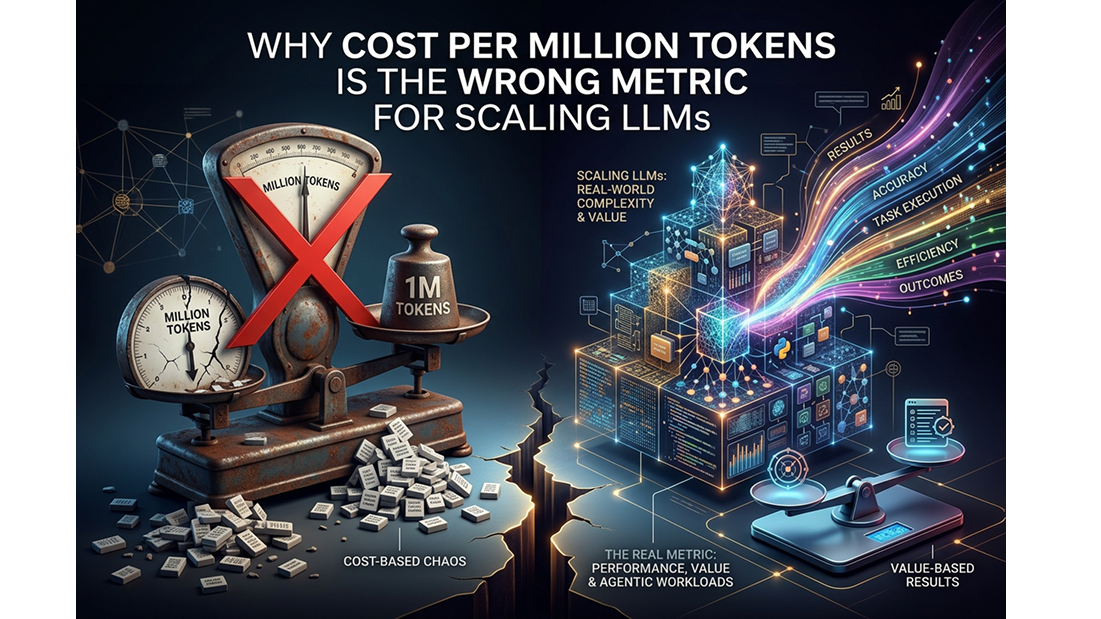
The problem isn't hidden fees or deceptive billing. The problem is that Cost per Million Tokens is a vanity metric. It measures raw data volume in an ideal sandbox, completely ignoring system reliability, tokenization efficiency, prompt bloat, latency trade-offs, and retry rates.
Evaluating LLMs on CPMT alone is like buying a delivery fleet based solely on the price of gasoline per gallon, while ignoring engine fuel efficiency, maintenance failure rates, payload capacities, and traffic delays.
The Headline Pricing Fallacy
Cost per Million Tokens assumes a simple 1:1 relationship: if Model A costs half as much per token as Model B, running Model A will cut your AI infrastructure bill in half.
In production environments, this logic breaks down immediately.
Different models tokenize text differently, output varying lengths of explanation for the exact same prompt, require different levels of retry logic to output valid JSON, and exhibit wildly different failure rates under peak API loads.
The 5 Hidden Drivers of Real LLM Costs
1. Tokenizer Efficiency Variance
Not all tokens are created equal. Models use different tokenizers (e.g., Tiktoken, Llama Tokenizer, Claude Tokenizer). A prompt containing code, non-English text, or complex structural JSON might consume 1,000 tokens on Model A, but require 1,400 tokens on Model B to represent the exact same characters.
Even if Model B boasts a 20% lower CPMT, its inefficient tokenizer negates those savings instantly.
2. Retry Overhead & Schema Failures
If a cheap model costs $0.10 per million tokens but fails to output valid structured JSON on 25% of requests, your application must retry the request or route it to a backup model.
- Model A ($1.00/1M Tokens): 99.5% schema adherence on first attempt. Total cost: $1.00 per 1M processed tokens.
- Model B ($0.30/1M Tokens): 70% schema adherence. Requires 1.4 retries per successful completion + logic overhead. Total cost: $0.42 + wasted engineering state + API latency penalties.
When retries increase, token volume multiplies, system reliability plummets, and end-user latency spikes.
3. Output Verbosity & Formatting Bloat
Output tokens are typically 3x to 5x more expensive than input tokens. Smaller or less fine-tuned models often suffer from extreme verbosity—adding conversational filler ("Sure, I can help you with that! Here is the JSON you requested:") despite system prompt instructions to return raw output.
A concise model returning 50 focused output tokens costs significantly less per request than a "cheaper" model that generates 250 preamble tokens to arrive at the same answer.
4. Context Window Expansion & System Prompt Bloat
To match the reasoning capabilities of state-of-the-art models, developers often build complex system prompts, dense Few-Shot examples, and extensive RAG context into cheaper models.
Passing an extra 8,000 tokens of system context on every API call to make a $0.20/1M token model perform like a $2.00/1M token model destroys your cost advantage.
5. Latency & Time-to-First-Token (TTFT) Compute Costs
In agentic workflows and real-time backend pipelines, slow LLM responses hold open HTTP connections, worker threads, and database transactions. If a low-cost API takes 4 seconds to stream a response compared to 800ms on a optimized enterprise provider, your downstream infrastructure (Kubernetes worker pods, serverless execution limits, memory utilization) bears the financial burden.
Metrics That Actually Matter for Production AI
To build sustainable, high-performing AI features, engineering teams must replace CPMT with metrics that capture total operational efficiency.
1. Effective Cost per Task (ECPT)
The total financial expenditure required to complete one successful, validated unit of work (e.g., one fully resolved customer support ticket, one parsed resume, or one generated SQL query).
2. Quality-Adjusted Throughput (QAT)
The volume of validated, accurate outputs generated per second, accounting for retries and error handling.
3. Token-to-Word Ratio
The precise number of tokens consumed by a specific model's tokenizer per 1,000 words of domain-specific input data (code, markdown, multilingual text).
4. Prompt Cache Hit Ratio
The percentage of recurring static context (system prompts, tool definitions, documentation grounding) served from cache at up to 80-90% discount versus full input processing rates.
Calculating Effective Cost per Task (ECPT)
To measure the true cost of an LLM feature, use the Effective Cost per Task formula:
$$ECPT = \frac{(T_{in} \cdot P_{in}) + (T_{out} \cdot P_{out}) + C_{retry} + C_{infra}}{S}$$
Where:
- $T_{in}$ / $T_{out}$: Total input and output tokens consumed across all attempts.
- $P_{in}$ / $P_{out}$: Unit price per input and output token.
- $C_{retry}$: Financial cost of failed attempts, validation loops, and fallback model invocations.
- $C_{infra}$: Downstream compute execution cost held during model latency.
- $S$: Count of successfully completed, validated tasks ($S \le \text{Total Attempts}$).
Real World Example:
Suppose you run 10,000 extraction tasks.
- Model Alpha ($0.50/1M input, $1.50/1M output): Requires zero retries, minimal prompt overhead. Total bill: $12.50.
- Model Beta ($0.15/1M input, $0.60/1M output): Requires 3,000 retries due to JSON formatting failures and long system prompts. Total bill + compute time: $18.20.
Despite Model Beta appearing 70% cheaper on paper, Model Alpha is 31% cheaper in production.
Architectural Solutions: Optimizing Real LLM TCO
Lowering your AI infrastructure costs doesn't mean hunting for the cheapest provider on a pricing table. It requires implementing intelligent routing, dynamic caching, and resilient fallback mechanisms.
1. Implement Dynamic Model Routing
Not every request requires a tier-one frontier model. Route simple intent-classification tasks to fast, low-cost models, while dynamically escalating complex multi-step reasoning tasks to advanced models.
2. Universal Prompt Caching
Structure your API payloads to isolate static context (tool schemas, core guidelines) from variable context (user query). Maximize cache hits across all active providers.
3. Automatic Fallbacks & Retry Guardrails
Prevent catastrophic user timeouts and runaway retry costs by configuring automated fallback pipelines. If Provider A encounters high latency or rate limits, immediately route the request to Provider B without throwing application errors.
Streamline Your LLM Infrastructure with AnyAPI
Navigating token mechanics, tokenization quirks, and provider availability across dozens of endpoints shouldn't require custom in-house middleware.
AnyAPI.ai provides a single, unified gateway for all major LLM providers (OpenAI, Anthropic, Google, open-source models, and hosted endpoints). With AnyAPI, technical teams gain:
- Smart Cost-Based Routing: Automatically direct queries to the most cost-effective model capable of handling the task's complexity requirements.
- Unified Fallback Resilience: Eliminate API downtime and schema retries with zero-latency automated provider failover.
- Global Prompt Caching: Standardize prompt caching mechanics across multiple providers through a single API payload structure.
- Real-Time TCO Analytics: Track Effective Cost per Task, latency, and success rates across all models from a single unified dashboard.
Stop optimizing for vanity pricing tables. Start building resilient, cost-efficient AI infrastructure with AnyAPI.ai.
Frequently Asked Questions
Why do different LLM providers bill differently for the same prompt?
Different models utilize unique tokenizer algorithms. The same paragraph of text may break down into 100 tokens on one provider and 140 tokens on another. Additionally, providers offer varying discounts for prompt caching and batch execution.
Is prompt caching more important than raw token price?
In many production systems, yes. If your application sends large system prompts, background context, or API tool definitions with every user query, prompt caching can reduce input costs by up to 80–90%, making context structure far more impactful than baseline token costs.
How does AnyAPI help lower Effective Cost per Task?
AnyAPI acts as a unified LLM gateway that optimizes routing, manages retries, enforces fallbacks, and standardizes caching across all top-tier AI providers—reducing engineering overhead and eliminating wasted API usage.
.svg)