



Building production-grade AI applications in 2026 requires orchestrating dozens of language models across multiple providers. Whether you are running agentic reasoning loops with GPT-5.6 Sol and Claude Fable 5, or routing high-volume structured data extraction to GLM-5.3 Flash and DeepSeek V4, hardcoding provider-specific SDKs creates immediate technical debt.
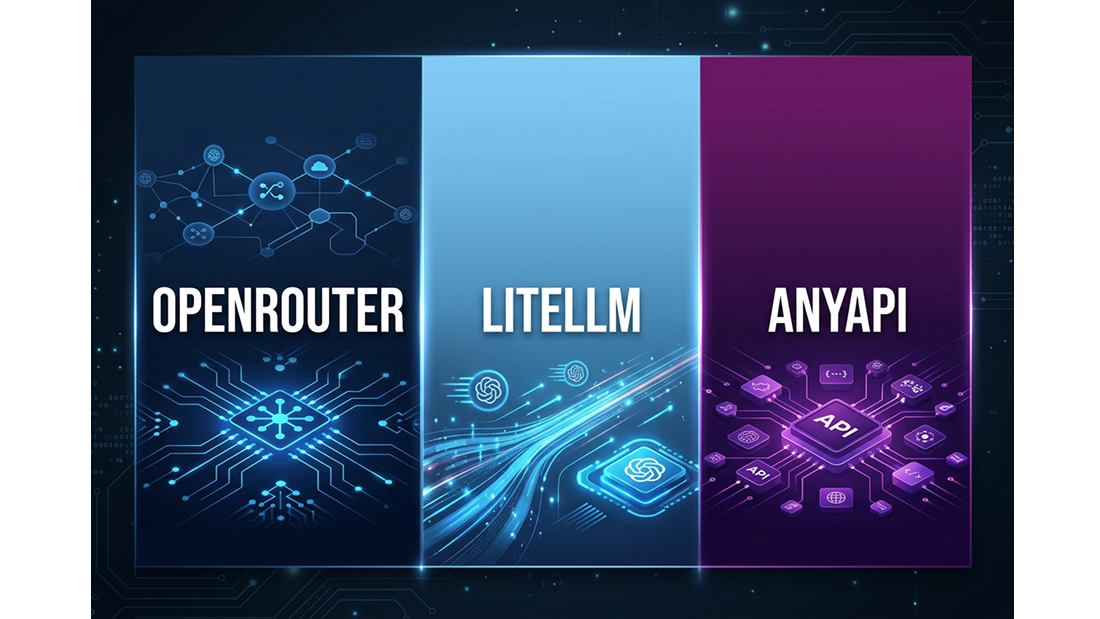
To unify API interfaces, manage rate limits, and enforce cost controls, engineering teams turn to LLM Gateways. However, the three market leaders—OpenRouter, LiteLLM, and AnyAPI.ai—architecturally solve this problem in fundamentally different ways.
This guide analyzes the core trade-offs between OpenRouter's consumer aggregator model, LiteLLM's self-hosted proxy framework, and AnyAPI's enterprise managed gateway.
The Architectural Divide: Marketplace vs Self-Hosted vs Managed Gateway
Selecting an LLM gateway is primarily an infrastructure decision. The three solutions represent three distinct operational paradigms:
OpenRouter: The Public Aggregator Marketplace
OpenRouter functions as a unified consumer marketplace. It abstracts model access behind a single API key and handles crypto/credit billing.
- Best for: Prototyping, hackathons, and individual developers who want instant access to hundreds of open-source and proprietary models without managing individual API accounts.
- Architectural Bottleneck: All traffic routes through OpenRouter's centralized infrastructure using shared rate limit buckets, creating potential latency variance and privacy compliance concerns for enterprise workloads.
LiteLLM: The Self-Hosted Open-Source Proxy
LiteLLM is an open-source Python/Rust proxy that translates OpenAI-formatted requests into 100+ provider formats. You host it on your own infrastructure (AWS, GCP, Kubernetes).
- Best for: Engineering teams with strict data residency constraints who want full control over proxy code and are willing to manage deployment, load balancing, and Redis caching layers.
- Architectural Bottleneck: High operational maintenance. Your team becomes responsible for proxy uptime, edge distribution, scaling worker nodes, and updating proxy schemas whenever providers change their API contracts.
AnyAPI.ai: The Turnkey Managed Gateway Mesh
AnyAPI.ai provides a zero-maintenance, enterprise-grade unified gateway. It combines the ease of integration of a managed service with the performance and security of dedicated edge infrastructure.
- Best for: Production AI teams, SaaS platforms, and agentic workflows requiring 99.99% availability, zero-downtime auto-failover, and ultra-low routing overhead without hosting infrastructure.
- Architectural Bottleneck: Closed-source core gateway managed entirely as a turnkey SaaS service.
Feature & Performance Comparison Matrix
Proxy Latency and Edge Routing Mechanics
Every proxy layer introduces latency. In agentic execution chains where a single user query triggers 10 to 30 sequential LLM calls, an additional 100ms of proxy overhead compounds into 3 full seconds of added user-perceived delay.
Sequential Agent Loop Latency Accumulation (10 Steps):
- OpenRouter Latency: Routes through central regional hubs. High-concurrency spikes often lead to queueing delays, making it less ideal for real-time streaming applications.
- LiteLLM Latency: Minimal proxy translation overhead (~5ms), but overall performance depends heavily on your deployment geometry. If your application runs in AWS us-east-1 and your self-hosted LiteLLM instance is in a single region, cross-region routing to European provider nodes introduces network latency.
- AnyAPI.ai Latency: Operates a globally distributed edge mesh. Requests terminate at the nearest edge pop and route over optimized backbones directly to provider endpoints, keeping proxy overhead under 15ms globally.
Failover Engineering: Rate Limits, Outages, and Fallbacks
Provider outages (503 Service Unavailable) and rate limits (429 Too Many Requests) are inevitable when scaling AI applications. How gateways handle these failures dictates whether your app stays online.
Handling 429 & 503 Errors in LiteLLM vs AnyAPI
In LiteLLM, you must manually define complex YAML fallback configurations and manage failure states across workers:
# litellm_config.yaml (Manual Configuration Required)
model_list:
  - model_name: agent-brain
    litellm_params:
      model: openai/gpt-5.6-sol
      api_key: os.environ/OPENAI_API_KEY
  - model_name: agent-brain
    litellm_params:
      model: deepseek/deepseek-v4
      api_key: os.environ/DEEPSEEK_API_KEY
router_settings:
  num_retries: 3
  allowed_fails: 2
  cooldown_time: 30
Problem: If a provider changes error payload structures or encounters subtle soft-rate-limits, self-hosted config rules often fail to catch the error, requiring hot-reloading configurations in production.
In AnyAPI.ai, failover is handled dynamically at the gateway mesh level. If GLM-5.3 or Claude Fable 5 experiences elevated latency or returns a 429 status code, AnyAPI automatically reroutes the payload to a designated standby node (DeepSeek V4) within milliseconds without dropping the HTTP stream.
Integration Examples: Single Interface for All Models
Both OpenRouter, LiteLLM, and AnyAPI support the standard OpenAI REST interface. Moving between them requires changing only the base_url and api_key.
AnyAPI Python SDK / OpenAI SDK Integration
import os
from openai import OpenAI

# AnyAPI unified gateway endpoint initialization
client = OpenAI(
    api_key=os.getenv("ANYAPI_API_KEY"),
    base_url="https://api.anyapi.ai/v1"
)

# Seamlessly switch between 2026 models without changing SDK methods
response = client.chat.completions.create(
    model="glm-5.3-pro", # Automatically routes to optimal provider endpoint
    messages=[
        {"role": "system", "content": "You are a production code generation agent."},
        {"role": "user", "content": "Refactor this SQL query for distributed execution."}
    ],
    temperature=0.2,
    extra_body={
        "anyapi_config": {
            "fallback_models": ["gpt-5.6-sol", "deepseek-v4"],
            "retry_on_status": [429, 500, 503]
        }
    }
)

print(response.choices[0].message.content)
Total Cost of Ownership (TCO) and DevOps Overhead
When evaluating gateways, engineering teams often overlook the operational cost of self-hosting.
The Real Cost of Self-Hosting LiteLLM
While LiteLLM software is free and open-source, running it in production requires:
- Infrastructure: 2x Kubernetes pods for HA + Redis cluster for caching/rate-limiting (~$150–$400/month).
- Engineering Hours: ~10–15 hours per month spent upgrading proxy images, managing API key rotation, tuning routing rules, and responding to proxy downtime alerts.
- Total Estimated TCO: $1,500 – $3,500/month in combined infrastructure and engineering maintenance costs.
AnyAPI Managed Value Proposition
AnyAPI converts variable DevOps overhead into a predictable turnkey service. You eliminate proxy infrastructure management entirely while obtaining enterprise SLAs, multi-region routing, and zero-downtime failovers out of the box.
Final Verdict: Choosing the Right Gateway for Your Scale
- Choose OpenRouter if: You are building side projects, experimenting with dozens of obscure open-source models, or need a quick playground environment without setting up individual provider billing.
- Choose LiteLLM if: You have dedicated DevOps resources, operate strict air-gapped VPCs, and require total control over proxy source code.
- Choose AnyAPI.ai if: You are scaling production SaaS, agent pipelines, or enterprise AI applications that require 99.99% availability, ultra-low latency, and zero maintenance overhead.
Frequently Asked Questions
Can I bring my own provider keys (BYOK) to AnyAPI?
Yes. AnyAPI supports both managed unified billing and Bring-Your-Own-Key (BYOK) configurations, allowing you to leverage volume discounts directly with OpenAI, Anthropic, or Google while utilizing AnyAPI's failover infrastructure.
How does AnyAPI guarantee lower latency than self-hosted proxies?
AnyAPI utilizes a distributed edge routing network that terminates TLS connections close to your application servers and maintains pre-warmed connection pools to underlying LLM providers.
What happens if a primary model provider goes completely offline?
AnyAPI's smart gateway detects upstream 5xx errors or connection timeouts instantly, routing your request to a pre-configured standby model with identical schema capabilities in under 50ms.
%201.png)