




A model can look impressive in a demo and still be a poor fit for a live application. The questions change once real users arrive: How often does it complete the task correctly? How long does each response take? What happens to the bill when requests grow?
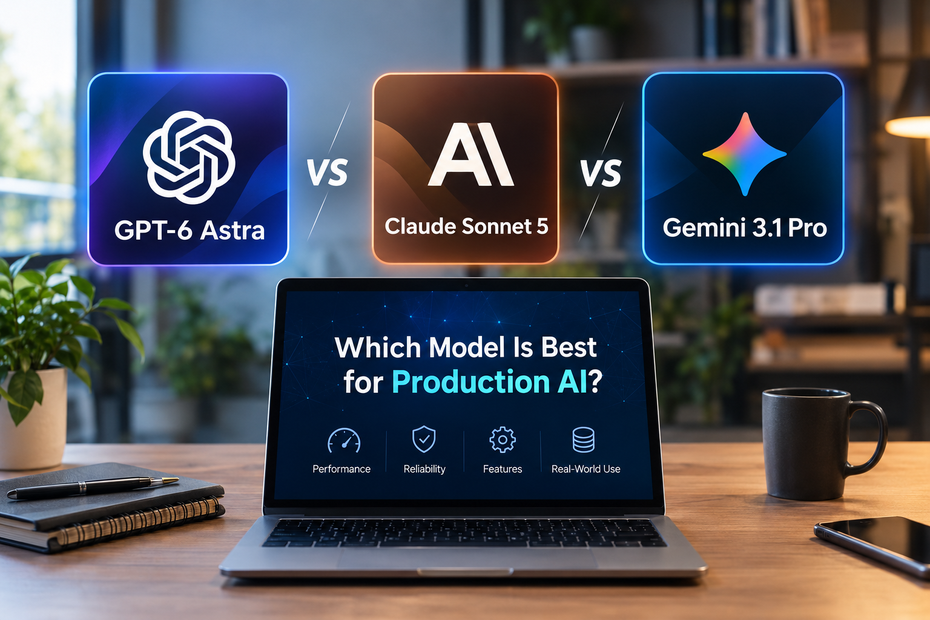
This GPT-6 Astra vs Claude Sonnet 5 vs Gemini 3.1 Pro comparison looks at those practical decisions. All three are capable models, but they serve different needs. The right choice depends on the work your application gives them, the level of review available and the cost of a wrong answer.
Start With the Job, Not the Model Name
Before an LLM comparison, write down the tasks your application performs. An internal coding agent, a customer-facing assistant, and a tool that reads large collections of documents should not be judged by the same few prompts.
Create a test set from realistic requests, including incomplete instructions and difficult cases. Score whether each model finishes the task, follows the required format, and uses tools correctly. Record response time and the cost of the whole task, including retries. That gives you a more useful AI model performance comparison than a single benchmark score.
GPT-6 Astra: For Demanding, Multi-Step Tasks
GPT-6 Astra is designed for complex reasoning, software engineering, research, and workflows that use tools. It is a strong candidate when an application needs to investigate a problem, take several steps and check its result. OpenAI also lets developers adjust its reasoning effort, which is worth testing at the setting intended for production.
Its direct API price is substantial: standard GPT-6 API pricing for Astra is $10 per million input tokens and $50 per million output tokens. Per-token price, however, does not tell the whole story. A model that finishes a difficult job with fewer attempts may cost less per successful task than a cheaper model that repeatedly fails.
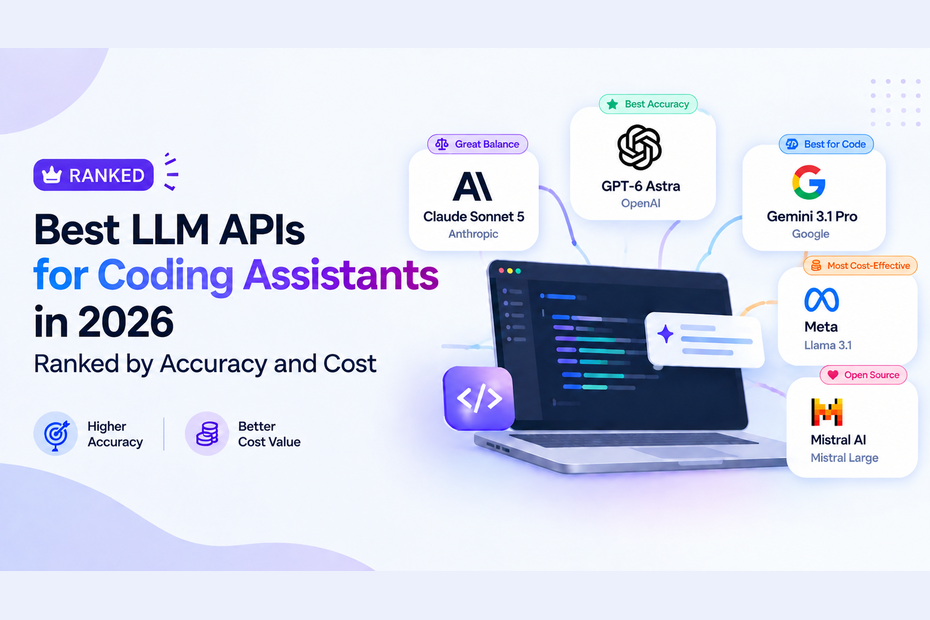
Astra deserves testing for complex agent workflows and code changes. It is harder to justify for every short, routine reply unless your results show a clear benefit. AnyAPI lists Astra in its catalogue for teams comparing models through a unified API.
Claude Sonnet 5: A Lower-Priced Model for Interactive Work
The Claude Sonnet 5 API offers a different cost profile. Anthropic's standard direct rate is $2 per million input tokens and $10 per million output tokens. Sonnet 5 supports a large context window, tool use, and adaptive thinking, making it a candidate for coding assistance, document work, and interactive features.
For a production assistant, test whether it responds clearly to follow-up questions, keeps to the supplied information, and handles tool results as expected. Its lower token price makes it particularly interesting for features used frequently, though actual spend will still depend on request length and the number of calls.
One integration detail needs checking before deployment: Sonnet 5 is available through Anthropic's API, but its availability through a particular gateway should be confirmed in that gateway's live model list. Do not assume that access to earlier Sonnet versions includes this one.
Gemini 3.1 Pro: For Large and Mixed Inputs
Gemini 3.1 Pro Preview is worth considering when users provide more than plain text. Google documents support for text, images, video, audio, and PDFs as inputs, along with function calling, structured outputs, and search grounding. That combination may suit an application that examines lengthy material or brings several types of input together.
Google's direct standard rate for prompts up to 200,000 tokens is $2 per million input tokens and $12 per million output tokens. Higher rates apply when a prompt exceeds that threshold. Teams working with long documents should test typical input sizes rather than estimate costs from a short sample request.
The model's API name includes Preview. For a live feature, check the version and change notices, test its behavior after updates, and keep a fallback path. AnyAPI lists Gemini 3.1 Pro Preview in its model catalogue.
Which One Should a Production Team Choose?
There is no single best AI model for production across every feature. Start by assigning each model a job to prove:
- Test GPT-6 Astra on difficult, multi-step tasks where a failed result creates substantial rework.
- Test Claude Sonnet 5 on frequent interactive tasks where response quality and ongoing cost both matter.
- Test Gemini 3.1 Pro Preview when large or mixed-format inputs are central to the feature.
Run the same real examples through each candidate, then compare accepted results, time and total cost. If different models win different tasks, the application may benefit from routing requests rather than forcing one model to handle everything. Make that decision from your own test results and confirm model availability with the API service you plan to use.