



The Contenders: Who is Who?
Before diving into the data, let’s define what makes each model unique and how they represent fundamentally different architectural philosophies.
1. GLM-5.2 (Zhipu AI)
GLM-5.2 represents a massive shift for open-weights technology. Clocking in as a 744-billion-parameter Mixture-of-Experts (MoE) model with roughly 40 billion active parameters per token, it is fully open-weights under a developer-friendly MIT license. It features native "thinking modes" (disabled, high, and max) that allow engineers to scale test-time compute based on task complexity.
2. GPT-5.5 (OpenAI)
Released in late spring 2026, GPT-5.5 shifts the focus from raw scale to steerability and process minimization. It is an "outcome-focused" closed model built specifically to minimize prompt scaffolding. It anchors OpenAI's cloud-agent framework, proving exceptionally stable when handed vague, loosely defined engineering targets that require independent validation steps.
3. Claude Opus 4.8 (Anthropic)
Anthropic's premium flagship model is engineered entirely for high-stakes, long-horizon asynchronous orchestration. Operating with an incredibly stable 1-million-token context window, Claude Opus 4.8 features "Dynamic Workflows," allowing it to spin up internal subagents to debug codebases and catch its own logical errors before finalizing a terminal output.
Coding Benchmarks: Human Preference vs. Synthetic Eval
Evaluating coding models requires separating artificial tests from real-world utility. While synthetic benchmarks provide a baseline, interactive leaderboards based on human code reviews paint a much more accurate picture.
On Design Arena, which evaluates head-to-head human preference in production-grade code reviews, GLM-5.2 has achieved the number one overall ranking, slightly edging out Claude Opus 4.8. This is primarily because GLM-5.2 outputs highly idiomatic, clean code without the chatty verbosity often found in earlier models.
However, when looking at objective, multi-file software engineering benchmarks, the performance distribution shifts:
- SWE-bench Verified (Complex Code Base Edits): Claude Opus 4.8 dominates here with an 88.6% success rate. It excels at parsing massive, ambiguous repositories and tracking deep multi-file dependencies.
- SWE-bench Pro: GLM-5.2 scores a highly competitive 62.1%, surpassing GPT-5.5's 58.6%.
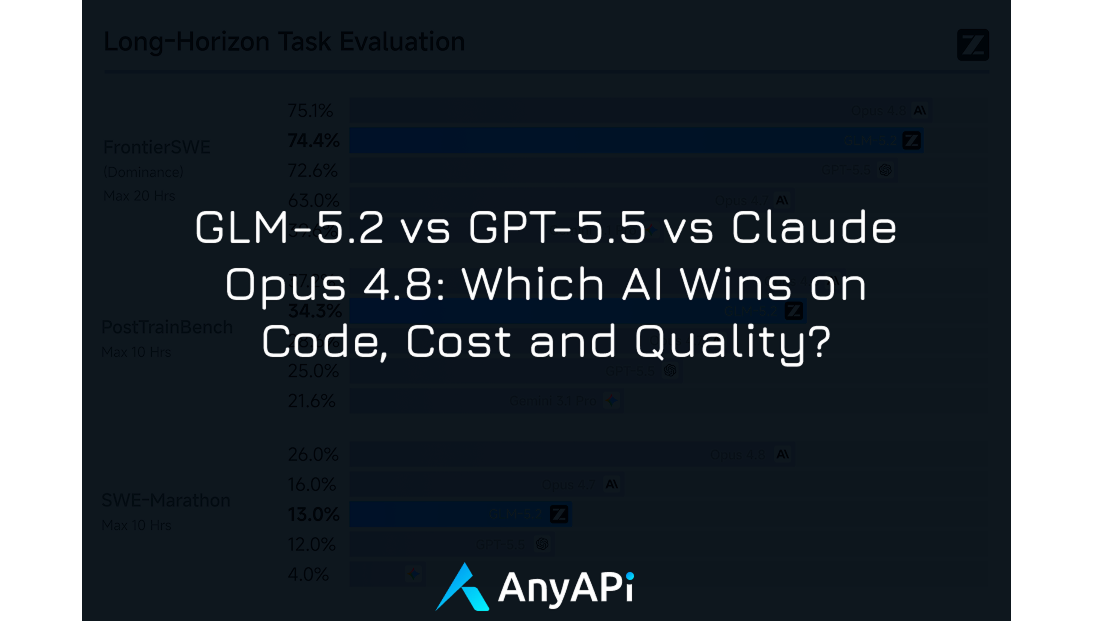
- FrontierSWE (Long-Horizon Engineering): Claude Opus 4.8 (75.1%) and GLM-5.2 (74.4%) are effectively tied, leaving GPT-5.5 slightly behind at 72.6%.
- Terminal-Bench 2.1 (Autonomous CLI Operations): GPT-5.5 takes the crown here, successfully completing 82.0% of tasks when using its "xhigh" reasoning mode, proving its superior capabilities for server management and DevOps agent scaffolding.
The Economics of Token Pricing
While quality remains highly competitive across all three models, their token economics are completely night and day. If your platform runs recursive agent loops that consume tens of millions of tokens daily, pricing becomes your primary architectural bottleneck.
Let’s look at the standard API commercial rates per 1 million tokens:
Model EndpointsInput Cost (per 1M)Output Cost (per 1M)Cost Ratio (vs. GLM)Primary Financial TraitGLM-5.2 (Hosted API)$1.40$4.401x (Baseline)Deeply disruptive cost-to-performanceClaude Opus 4.8$5.00$25.00~5.3x more expensiveExcellent automated prompt caching reductionsGPT-5.5$5.00$30.00~6.4x more expensiveHigh cost, but uses fewer process tokens
The 50M Token Simulation: Suppose your autonomous coding tool processes 50 million tokens a month with a balanced 50/50 input-to-output split.
- GLM-5.2: $145 / month
- Claude Opus 4.8: $750 / month
- GPT-5.5: $875 / month
Choosing GLM-5.2 saves your team up to $730 a month per developer seat on API costs alone. Furthermore, because GLM-5.2 is open-weights, enterprise teams under strict compliance mandates can self-host the model on private GPU infrastructure, completely removing per-token API fees.
Agentic Capabilities and Tool Execution
Writing code is one thing; executing it within a secure runtime loop is another.
- Claude Opus 4.8 remains the most reliable foundation for multi-stage autonomous agents. Its native integration with tools like Claude Code allows it to handle complex dependency chains, react to failing test suites, and independently change course without crashing. It scores an impressive 84% on the Online-Mind2Web browser-agent evaluation.
- GPT-5.5 excels at direct tool usage and constraint compliance. Because it is highly steerable and outcome-focused, you spend less time writing complex prompt guardrails. It simply requires a well-defined engineering ticket to get the job done correctly.
- GLM-5.2 matches both closed models on the MCP-Atlas (Model Context Protocol) framework, scoring a solid 76.8%. However, to reach its peak reasoning potential, you must explicitly enable its "Max Thinking" parameter, which introduces a slight latency trade-off during test-time computation.
Architectural Verdict: How to Choose via AnyAPI
No single model wins across every category. The ideal production architecture requires utilizing each model for its unique strengths.
- Deploy GLM-5.2 for high-volume coding automation, massive code indexing, repetitive file updates, and any workflow requiring a 1M context window at a fraction of standard frontier pricing.
- Route to Claude Opus 4.8 when your agent encounters highly ambiguous, critical architectural decisions or high-stakes refactoring tasks where a broken output would prove costly.
- Leverage GPT-5.5 when your workflow depends heavily on server terminal orchestration, managed platform stability, or structured desktop-agent control loops.
Unifying Your Stack with AnyAPI.ai
Instead of cluttering your code with three separate SDKs, managing multiple authentication headers, and dealing with separate corporate invoices, AnyAPI.ai unifies your infrastructure.
AnyAPI allows you to orchestrate GLM-5.2, GPT-5.5, and Claude Opus 4.8 through a single standardized endpoint payload. You can dynamically swap models or set up automated failovers with a single string change:
// POST to https://api.anyapi.ai/v1/chat/completions
{
  "model": "zhipu/glm-5.2-max",
  "messages": [
    {
      "role": "user",
      "content": "Refactor this database migration script for postgres."
    }
  ],
  "fallback_model": "anthropic/claude-opus-4.8",
  "temperature": 0.2
}
This approach gives your development team ultimate flexibility. You can leverage the ultra-low token costs of GLM-5.2 for standard generation pipelines, while keeping Claude Opus 4.8 or GPT-5.5 ready as a fallback option—ensuring maximum quality, total cost control, and zero vendor lock-in.
Frequently Asked Questions
Can GLM-5.2 really match Claude Opus 4.8 in code generation?
Yes, on human preference environments like the Design Arena leaderboard, GLM-5.2's output code style is highly preferred by developers. However, for large-scale, multi-file codebase refactoring, Claude Opus 4.8 retains a noticeable advantage due to its advanced long-context reasoning stability.
Does GPT-5.5 charge for internal thinking tokens?
Yes, like most modern reasoning engines, GPT-5.5 charges for the internal tokens generated during its thinking process. This makes precise pricing variable depending on task complexity, which is why utilizing an open-weight alternative like GLM-5.2 can help keep high-volume production costs highly predictable.
How does AnyAPI handle failovers if a provider goes down?
AnyAPI includes built-in routing logic. If your primary chosen model endpoint experiences a localized outage or returns a 429 rate-limit error, AnyAPI can automatically route the payload to your designated fallback model (e.g., switching from a closed API to a hosted open-weights alternative) instantly without breaking your application uptime.