





The demo worked perfectly. Your proof of concept impressed stakeholders. The pilot got approved with real budget behind it. Then somewhere between prototype and production, everything fell apart.
If this sounds familiar, you're not alone. According to recent industry data, roughly 85% of AI projects never make it to production or fail to deliver measurable business value. And the problem is getting worse, not better. As we move into 2026, the gap between AI experimentation and AI profitability has become the defining challenge for engineering teams everywhere.
The uncomfortable truth? The failure point is rarely the model itself. It's almost always the infrastructure layer underneath it.
The Real Reason AI Projects Stall Out
When teams dissect failed AI initiatives, they tend to blame familiar suspects: bad data quality, unclear requirements, or organizational resistance. These factors matter, but they're often symptoms rather than root causes.
The deeper issue is architectural. Most AI projects start with a single provider, a single use case, and a single integration path. This feels efficient in week one. By month three, it becomes a trap.
Teams lock themselves into pricing structures that don't scale. They build around capabilities that get deprecated or rate limited. They hardcode assumptions about latency, token costs, and model behavior that stop being true the moment they try to expand.
The result is technical debt that compounds faster than anyone anticipated, and business cases that collapse under the weight of unexpected infrastructure costs.
How the LLM Landscape Changed Everything
Two years ago, choosing an AI provider was straightforward. You picked OpenAI or maybe Anthropic, integrated their API, and moved on with your life.
That simplicity is gone. The current landscape includes dozens of viable foundation models, each with distinct strengths. Claude excels at nuanced reasoning and longer context windows. GPT-4o handles multimodal tasks with remarkable fluency. Mistral and Llama variants offer compelling price performance ratios for specific workloads. Specialized models from providers like Cohere or AI21 outperform generalist options for particular domains.
This abundance should be good news. In practice, it creates paralysis. Teams either commit too early to a single provider and miss better options, or they attempt multi-provider architectures that turn into maintenance nightmares.
The infrastructure layer that worked for single-provider setups simply breaks when you need orchestration across multiple models, intelligent routing based on cost or latency, and graceful fallbacks when any individual service degrades.
Why Traditional API Integration Falls Short
The standard approach to AI integration looks something like this: pick a provider, install their SDK, write wrapper functions, ship it. When you need a second provider, repeat the process. When you need intelligent routing, build custom logic. When you need unified observability, bolt on another tool.
This pattern creates three predictable problems.
First, every provider has different authentication flows, error handling patterns, response formats, and rate limiting behaviors. Your codebase accumulates provider-specific conditionals that make testing painful and debugging worse.
Second, cost optimization becomes nearly impossible. Without unified tracking across providers, you can't answer basic questions like which model delivers the best results per dollar for a given task type.
Third, you lose flexibility precisely when you need it most. Switching providers or adding new ones requires significant engineering effort, which means you stay locked into suboptimal choices longer than you should.
The math doesn't work. Teams report spending 40% or more of their AI engineering time on infrastructure concerns rather than actual product development.
The Multi-Provider Architecture That Actually Scales
The teams generating real ROI from AI have converged on a different pattern. Instead of direct integrations with individual providers, they route through an abstraction layer that handles interoperability, load balancing, and unified API management.
The architecture looks deceptively simple:
What happens under the hood is more sophisticated. The gateway evaluates available providers, considers current rate limits and latency, applies cost optimization logic based on task requirements, and routes accordingly. If the primary provider fails or responds slowly, traffic shifts automatically.
This approach delivers three immediate benefits. Engineering teams write against one consistent interface regardless of how many providers they use. Operations teams get unified monitoring and spend tracking. Product teams gain the flexibility to experiment with new models without infrastructure changes.
What High-ROI AI Teams Do Differently
The 15% of AI projects that deliver measurable returns share common patterns worth studying.
They treat provider selection as an ongoing optimization problem, not a one-time decision. The best model for your use case in January might not be the best option in June. High-performing teams build for switchability from day one.
They instrument everything. Unified logging across providers, standardized metrics for cost per task, latency percentiles by model, and quality scores where measurable. You cannot optimize what you cannot observe.
They separate orchestration logic from business logic. When routing rules, fallback behavior, and provider selection live in a dedicated infrastructure layer, product engineers can focus on product problems instead of integration headaches.
They embrace multi-provider strategies without apology. Using Claude for complex reasoning, GPT-4o for multimodal inputs, and an open source model for high volume, low complexity tasks isn't complexity for its own sake. It's rational cost and performance optimization.
The teams struggling with AI ROI almost always share the inverse patterns: single provider lock-in, minimal observability, and infrastructure concerns scattered throughout application code.
Building for the Next Phase of AI Infrastructure
The companies that will thrive in the next wave of AI development are already building differently. They recognize that LLM infrastructure is following the same trajectory as cloud infrastructure a decade ago. Early on, everyone built custom. Eventually, standardized abstraction layers emerged that let teams focus on differentiation rather than undifferentiated heavy lifting.
API flexibility and interoperability are becoming baseline requirements, not nice to have features. The ability to swap providers, route intelligently across models, and maintain unified observability across a heterogeneous AI stack determines whether projects reach production profitability or join the 85% that never get there.
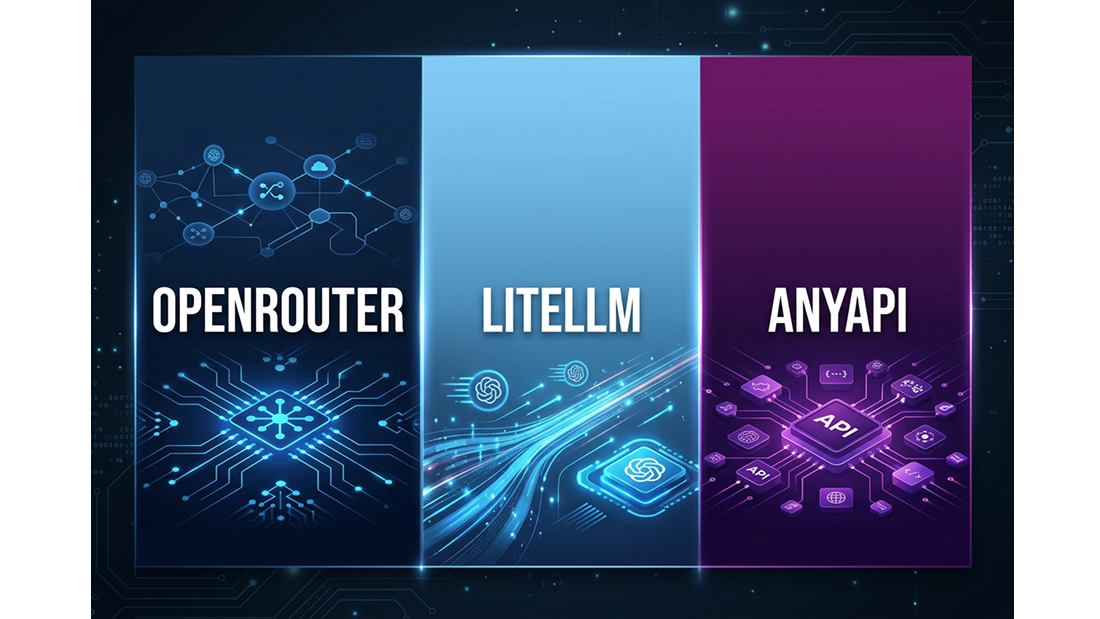
This is the direction the entire ecosystem is moving. Platforms like AnyAPI are building toward this future, creating infrastructure that treats multi-provider orchestration as a first-class concern rather than an afterthought. The goal is straightforward: let engineering teams spend their time on problems that actually differentiate their products.
The AI ROI crisis isn't inevitable. It's a symptom of infrastructure patterns that made sense two years ago and don't anymore. The teams updating their approach are the ones turning AI experiments into revenue. Everyone else is still debugging provider-specific edge cases.