




Building AI applications around a single provider’s direct endpoint is an operational liability. Whether you are running user-facing conversational interfaces or autonomous agent loops, direct provider calls expose your architecture to unpredictable downtime, regional latency spikes, and stringent HTTP 429 Too Many Requests rate limits.
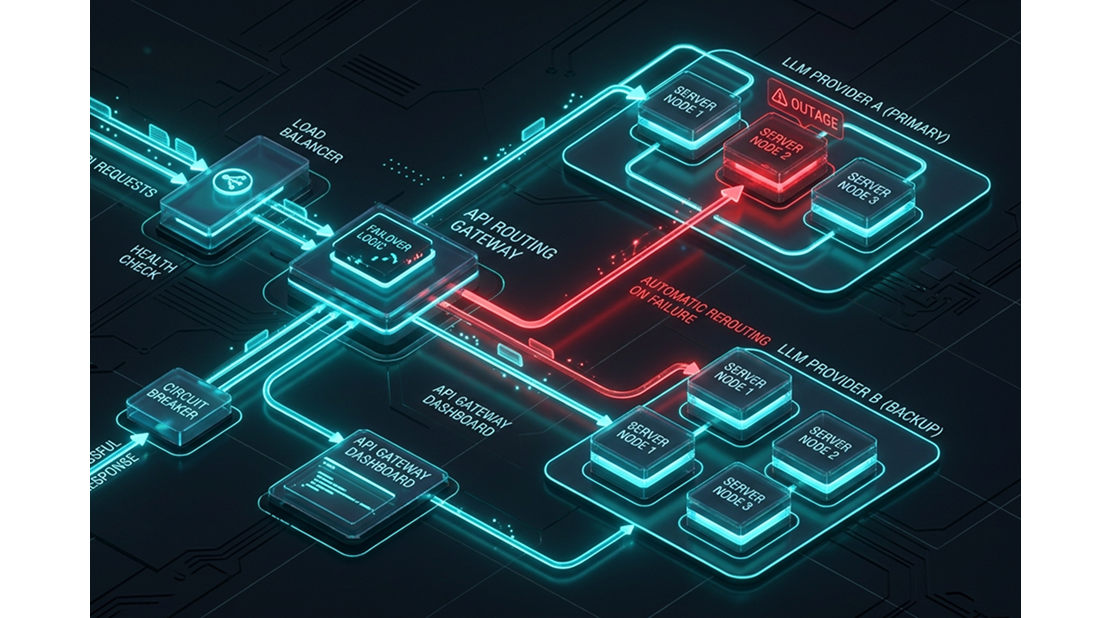
When a primary model provider drops requests, an autonomous sub-agent crashes, losing state and halting background execution. To achieve production-grade availability (99.99%), engineering teams must implement LLM API Failover—an architectural layer that dynamically shifts execution traffic across alternative endpoints, backup providers, and fallback models.
This guide breaks down common LLM failure points, resilient architectural patterns, and how to deploy automated failover using AnyAPI.ai.
The Hidden Cost of Single-Provider LLM Outages
When traditional APIs fail, they usually return a standard error code and recover quickly. In contrast, LLM failure states are complex. Upstream provider congestion can lead to partial degradations—such as stream dropouts midway through structured JSON generations—or sudden rate-limit throttling during peak usage hours.
For agentic software, a single dropped request breaks multi-turn execution flows, corrupts session memory, and forces users to restart tasks manually. Handling resilience at the application level by wrapping every API call in custom try/except loops quickly turns codebases into fragile, unmaintainable boilerplate.
Core Failure Modes in AI Production Pipelines
Designing a proper failover matrix requires identifying the distinct ways model endpoints fail:
- HTTP 429 (Rate Limits & Concurrency Exceeded): Caused by hitting strict Per-Minute (TPM) or Request-Per-Minute (RPM) thresholds during traffic bursts.
- HTTP 500 / 503 (Upstream Outages): Complete or localized server failure on the provider’s inference cluster.
- High TTFT (Time To First Token) Degradation: The endpoint responds, but latency spikes from 300ms to 12,000ms due to queue congestion.
- Mid-Stream Disconnections: The socket drops mid-generation, returning incomplete tool-call parameters or malformed JSON payloads.
Failover Architecture Patterns: Primary vs. Cascading
Resilient systems rely on two main failover architectures depending on the business context:
1. Same-Model Multi-Provider Failover
If your system relies on open-weight models like GLM-5.3 or DeepSeek V4 Pro, the exact same model weights can be hosted across multiple infrastructure providers. If Provider A returns an error, AnyAPI routes the identical payload to Provider B instantly, keeping output deterministic.
2. Tiered Cross-Model Cascading
When using proprietary frontier endpoints, identical host redundancy is unavailable. In this setup, you establish a fallback tier based on model capability:
LLM Gateway Comparison Matrix
Evaluating how different architectural approaches handle API resilience:
Implementing Automatic Failover with AnyAPI.ai
AnyAPI.ai operates as a global, high-availability model proxy and smart load balancer. By routing your application traffic through AnyAPI, failover logic is handled automatically at the gateway level before a failure ever reaches your application code.
Key Gateway Features
- Transparent Retries: Automatic exponential backoff for transient network hiccups.
- Zero-Latency Provider Switching: If a primary host returns non-200 status codes, AnyAPI re-issues the request to an operational standby node in milliseconds.
- Payload Normalization: Converts OpenAI, Anthropic, and open-weight payload structures into a unified format, allowing cross-model fallbacks without application code modifications.
Code Example: Resilient Multi-Provider Request Routing
Because AnyAPI presents a standard OpenAI-compatible interface, setting up resilient calls requires no specialized SDKs. You simply pass your model execution preference while AnyAPI handles fallback paths under the hood.
Python
import os
from openai import OpenAI

# Point client to AnyAPI gateway
client = OpenAI(
    api_key=os.getenv("ANYAPI_API_KEY"),
    base_url="https://api.anyapi.ai/v1"
)

try:
    # Request model execution with configured gateway fallbacks
    response = client.chat.completions.create(
        model="glm-5.3",  # Primary preference; gateway auto-routes to fallback if unavailable
        messages=[
            {"role": "system", "content": "You are a production agent performing code generation."},
            {"role": "user", "content": "Generate a resilient python retry decorator."}
        ],
        extra_body={
            "anyapi_routing": {
                "fallbacks": ["deepseek-v4-pro", "gpt-5.6-sol"],
                "max_retries": 3,
                "timeout_ms": 5000
            }
        }
    )

    print("Response Content:")
    print(response.choices[0].message.content)

except Exception as e:
    # Triggered only if ALL primary and secondary fallback routes fail
    print(f"Critical Pipeline Error: {e}")
Best Practices for Failover Thresholds & Caching
To avoid unintended costs or latent execution loops, apply these production rules when designing your failover strategy:
1. Set Aggressive Timeout Thresholds
Do not let requests hang indefinitely on stalled endpoints. Configure a 3,000ms–5,000ms timeout window on primary connections so AnyAPI can cut stalled requests early and pivot to a standby provider.
2. Cache Responses at the Gateway Layer
Repeated queries (such as static system prompts or identical diagnostic checks) should be served directly from memory. Enabling response caching on AnyAPI mitigates up to 30% of rate-limit bottlenecks before hitting model providers.
3. Separate Background & Real-Time Traffic
Route interactive user queries to fast, high-availability endpoints with strict fallback rules. Direct batch processing and asynchronous sub-agents to lower-cost open-weight models with wider backoff parameters.
Frequently Asked Questions
Does LLM failover increase overall API latency?
When managed efficiently by an edge proxy like AnyAPI, the latency overhead of health-checking and switching providers is less than 15 milliseconds—far faster than waiting for a timed-out connection to recover manually.
Can AnyAPI automatically translate function-calling formats during cross-model fallbacks?
Yes. AnyAPI normalizes function calls and structured JSON schemas across supported models (including GLM-5.3, DeepSeek V4, GPT-5.6 Sol, and Claude Fable 5), ensuring tools do not break when falling back to a different model family.
How do I prevent runaway billing during automatic fallbacks to expensive models?
In your AnyAPI dashboard, you can define capped fallback rules. For example, you can limit tier-escalations to cheap open-weight alternatives or set explicit daily spend limits per model tier.
Protect your application against provider downtime and rate limits with enterprise-grade model routing.
.svg)